Key Takeaways at a Glance
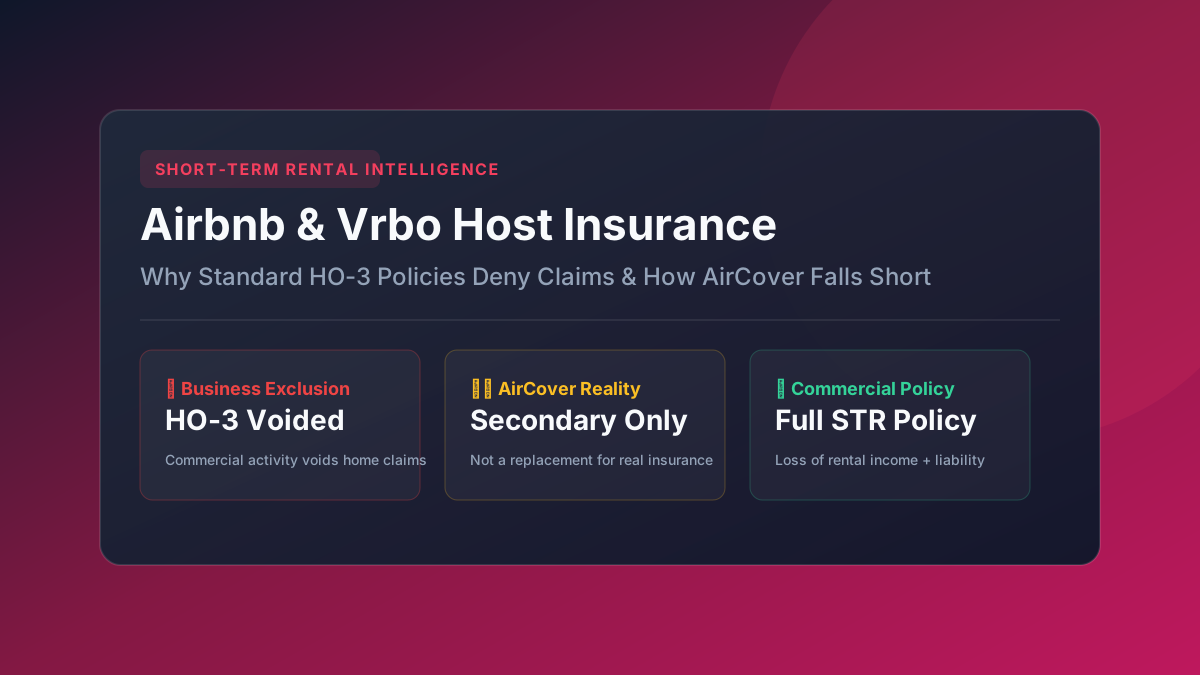
- The Business Activity Exclusion: Standard homeowner policies (HO-3/HO-5) strictly exclude losses arising from commercial rental activities. One booking can trigger claim denial.
- AirCover Is Not Insurance: Airbnb's host guarantee is secondary and discretionary. It does not replace structural hazard insurance or protect your personal mortgage escrow.
- Amenity Liability Risks: Hot tubs, swimming pools, bunk beds, and bicycles account for over 70% of guest injury lawsuits against short-term rental hosts.
- Dedicated STR Solutions: Replacing your HO-3 with a commercial hybrid policy (like Proper Insurance or CBIZ) provides unified coverage for personal use, guest damage, and lost revenue.
Estimate Replacement Cost for Your Rental Property
Whether renting a detached guest house or your entire home, benchmark dwelling replacement values using our Homeowners Insurance Calculator to avoid underinsurance penalties.
- 1. The Fatal HO-3 Policy Clause: "Business Pursuits" Exclusion
- 2. The Truth About Airbnb AirCover & Vrbo Liability
- 3. 4 Non-Negotiable Coverages Every Short-Term Rental Host Needs
- 4. High-Risk Amenities: Hot Tubs, Pools, Decks & Alcohol Liability
- 5. Dedicated STR Carriers: Proper Insurance vs. Foremost vs. CBIZ
- Frequently Asked Questions
1. The Fatal HO-3 Policy Clause: "Business Pursuits" Exclusion
More than 1.5 million Americans list residential properties on platforms like Airbnb, Vrbo, and Furnished Finder. The vast majority operate under the dangerous assumption that their standard homeowners policy (an ISO HO-3 or HO-5 form) will protect them if something goes wrong during a guest's stay.
Every standard homeowner policy in the United States includes an explicit exclusion for business pursuits and commercial property leasing. In the eyes of insurance adjusters and state courts, accepting monetary payment in exchange for lodging converts your residential haven into a commercial hotel. If a guest leaves a candle burning that destroys your living room, or slips on wet stairs breaking a hip, your personal insurer can lawfully deny the entire claim and terminate your policy on the grounds of unapproved material risk change.
2. The Truth About Airbnb AirCover & Vrbo Liability
Airbnb heavily markets its "AirCover for Hosts" program, boasting $3 Million in Host Damage Protection and $1 Million in Host Liability. While helpful for minor incidents, relying on platform coverage as your primary insurance strategy is dangerous:
| Coverage Feature | Standard HO-3 Homeowner | Airbnb AirCover Program | Dedicated Commercial STR Policy |
|---|---|---|---|
| Primary vs. Secondary | Primary (Personal only) | Secondary (Discretionary) | Primary Commercial Contract |
| Guest Slip & Fall Lawsuits | Denied (Business exclusion) | Limited to $1,000,000 | $1M – $2M Commercial CGL |
| Direct Guest Property Theft | Excluded for guests | Capped, requires police report | Full Replacement Cost |
| Lost Rental Revenue | $0 (Personal only) | Excluded for repairs | Actual Loss Sustained (12 Mo) |
| Off-Premise & Amenity Claims | Excluded | Strictly excluded | Included (Bikes, Kayaks, Hot Tubs) |
AirCover requires hosts to first seek reimbursement directly from the guest within 14 days. If the guest disputes the damage or closes their credit card, Airbnb arbitrates the claim internally. It is not an enforceable insurance policy regulated by state insurance commissioners.
3. 4 Non-Negotiable Coverages Every Short-Term Rental Host Needs
To protect personal assets, real estate equity, and rental cash flow, hosts must secure a specialized policy that includes four specific structural riders:
- Commercial General Liability (CGL): At least $1,000,000 per occurrence. This pays for legal defense, courtroom judgments, and medical expenses if a guest or their invitee is injured on the property.
- Building Replacement Cost (Special Form / All-Peril): Guarantees reconstruction without deducting for guest wear-and-tear or architectural depreciation.
- Loss of Business Income: If a fire, burst pipe, or storm forces you to cancel 6 months of reservations, this pays out the projected net revenue you would have earned based on your historical booking calendar.
- Guest Damage & Infestation Riders: Covers accidental damage, intentional vandalism, unauthorized parties, and bed bug remediation expenses ($5,000–$10,000).
4. High-Risk Amenities: Hot Tubs, Pools, Decks & Alcohol Liability
Adding attractive amenities generates higher nightly ADRs, but drastically elevates underwriting severity. According to legal claim registries, four features account for the vast majority of six-figure host injury claims:
- Hot Tubs & Spas: Slip injuries on wet decking and severe burns from improperly calibrated heater thermostats.
- Elevated Decks & Balconies: Structural collapse from guest overcrowding during gatherings or parties.
- Bicycles, Kayaks & Paddleboards: Providing sports equipment creates strict product liability if brakes fail or guests capsize in currents.
- Complimentary Wine / Alcohol: Offering a welcoming bottle of wine can expose hosts to social host liquor liability if intoxicated guests cause off-premise auto collisions.
5. Dedicated STR Carriers: Proper Insurance vs. Foremost vs. CBIZ
Depending on your occupancy model, you have three primary insurance pathways:
- Proper Insurance (Underwritten by Lloyd's of London): The gold standard for dedicated full-time STRs. Fully replaces your homeowner policy with a combined commercial property and liability contract, including bed bug coverage and full lost revenue.
- CBIZ Vacation Rental: Established national program offering comprehensive liability limits tailored to multi-unit resort and lakefront rentals.
- Carrier Endorsement Add-Ons: If you only rent your primary home for a few weekends per year (such as during major sporting events or college graduations), carriers like Allstate (HostAdvantage) or State Farm offer inexpensive riders added directly to your standard HO-3 policy.
Frequently Asked Questions
Does standard homeowners insurance cover Airbnb rentals?
No. Standard HO-3 and HO-5 homeowners insurance policies contain a strict 'business pursuits and commercial rental exclusion.' If a paying guest injures themselves or damages your home, your personal insurer will deny the claim and may cancel your policy.
Is Airbnb AirCover enough protection for hosts?
AirCover is a discretionary corporate guarantee, not an admitted insurance contract. It does not replace a comprehensive policy, does not cover off-premise guest lawsuits, excludes lost business revenue if local regulators intervene, and requires tedious guest dispute mediation before paying.
How much does dedicated short-term rental insurance cost?
A comprehensive commercial short-term rental policy (from carriers like Proper Insurance or CBIZ) typically costs between $1,800 and $3,500 per year, which is roughly 25% to 50% more than a standard residential homeowner policy, but fully covers commercial liability, building, and loss of rental revenue.