Key Takeaways at a Glance
- The Non-Negotiable $1M/$2M Standard: Commercial clients, municipal governments, and landlords universally demand a minimum $1 Million per occurrence / $2 Million aggregate CGL policy.
- What CGL Protects: Covers third-party bodily injury, property damage to client premises, products-completed operations, and copyright or advertising injury.
- Certificate of Insurance (COI): An official ACORD 25 certificate proves you have active liability coverage and names your client as an "Additional Insured."
- Contractor Subcontractor Trap: Failing to verify that your subcontractors carry active CGL coverage will trigger thousands in penalties during your annual insurance audit.
- 1. What Is Commercial General Liability (CGL) Insurance?
- 2. Decoding the Limits: What Does $1,000,000 / $2,000,000 Actually Mean?
- 3. The Anatomy of a Certificate of Insurance (COI)
- 4. How Much Does Commercial General Liability Cost in 2026?
- 5. Surviving the Annual Insurance Premium Audit
- Frequently Asked Questions
1. What Is Commercial General Liability (CGL) Insurance?
Whether you operate as an independent electrical contractor, a commercial painter, an IT consultant, or an LLC operating a retail boutique, Commercial General Liability (CGL) is the foundational cornerstone of business risk management.
Personal insurance policies specifically exclude business pursuits. If a client visits your home office and slips on an icy stair tread, or if you accidentally drop a power tool through a customer’s imported marble countertop on a jobsite, your personal homeowners and umbrella policies will deny the claim immediately.
Commercial General Liability shields your business entity and personal assets against third-party bodily injury, tangible property damage, and associated legal defense costs.
2. Decoding the Limits: What Does $1,000,000 / $2,000,000 Actually Mean?
When an enterprise client or general contractor requires you to show proof of a "$1M / $2M policy," they are referencing standard split liability limits:
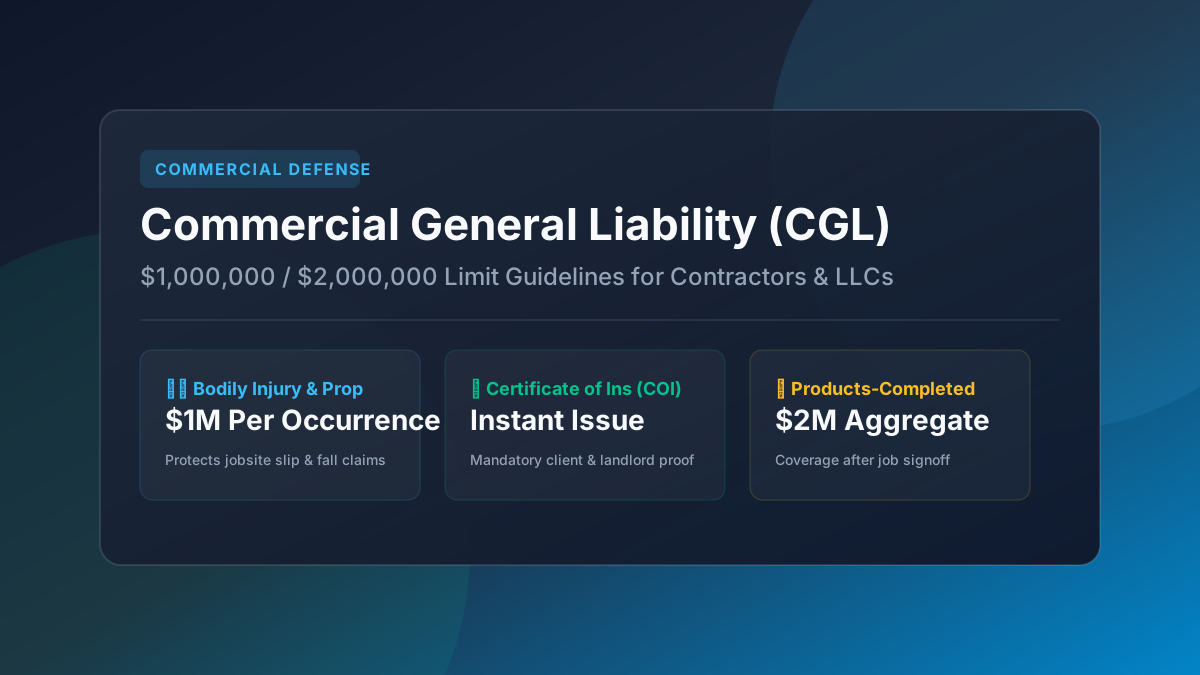
$1,000,000 Each Occurrence Limit: The maximum dollar amount the insurance company will pay for a single accident or incident. If an electrical short you wired causes a fire with $800,000 in property damage, the single occurrence limit fully covers the loss.
$2,000,000 General Aggregate Limit: The maximum total dollar amount the insurer will pay for all combined claims that occur during the entire 12-month policy period.
$2,000,000 Products-Completed Operations Aggregate: A critical sub-limit for trade contractors. It protects your business if work you completed 6 months ago fails—for example, a copper pipe joint you soldered fails, flooding a client’s server room weeks after you signed off on the job.
3. The Anatomy of a Certificate of Insurance (COI)
Before any general contractor allows you on a jobsite, or before a commercial landlord hands you the keys to an office lease, you must produce a Certificate of Insurance (ACORD 25 form).
| Certificate Field | What It Means | Why the Client Demands It |
|---|---|---|
| Insured Entity | Your legal business name / LLC | Verifies policy matches your subcontract agreement. |
| Insurer Afforded Coverage | The underwriting insurance company (A.M. Best A-rated) | Ensures your carrier has the financial solvency to pay claims. |
| Certificate Holder | The client, landlord, or general contractor | Grants legal notice if your policy is canceled or non-renewed. |
| Additional Insured Endorsement | Extends your liability shield to the client | Protects client if they are dragged into a lawsuit caused by your work. |
| Waiver of Subrogation | Insurer waives right to sue client | Prevents your carrier from suing client to recover claim expenses. |
4. How Much Does Commercial General Liability Cost in 2026?
CGL premiums are calculated based on your industry classification (NAICS / SIC code), your gross annual business revenue, your annual payroll, and your geographic location.
- Low-Risk Professionals (IT Consultants, Graphic Designers, Accountants): $350 to $600 per year ($30–$50/mo).
- Artisan Trade Contractors (Electricians, Drywallers, Painters, Landscapers): $800 to $1,800 per year ($70–$150/mo).
- High-Risk Trade Contractors (Roofers, Tree Trimmers, General Contractors): $2,800 to $6,500+ per year due to height and structural collapse exposure.
5. Surviving the Annual Insurance Premium Audit
Every CGL policy is subject to a mandatory Annual Premium Audit at the end of each policy term. When you bind your policy, your premium is estimated based on your projected annual revenue and payroll.
If your business grew faster than anticipated and your actual payroll doubled, the insurer will send an audit invoice demanding additional retroactive premium. Crucially, if you hired 1099 subcontractors during the year and cannot provide copies of their active Certificates of Insurance, the auditor will classify them as your direct employees and bill you for their exposure!
Compare Verified Rates in Your State
Benchmark rate filings from Progressive, State Farm, GEICO, Allstate, and Travelers with zero obligation.
Frequently Asked Questions
Q: Does Commercial General Liability cover damage to my own tools and equipment?
No. CGL strictly covers damage to OTHER people's property and third-party injuries. To protect your own tools, ladders, generators, and equipment, you must add an "Inland Marine / Contractor's Equipment" floater.
Q: What is the difference between General Liability and Professional Liability (E&O)?
General Liability covers physical accidents (slip and fall, smashed walls). Professional Liability (Errors & Omissions) covers financial losses resulting from professional advice, design errors, software bugs, or contractual mistakes.
Q: Can a single-member LLC be sued without General Liability?
Yes. While an LLC provides corporate asset separation, plaintiff attorneys can "pierce the corporate veil" for personal negligence, putting your home and personal bank accounts at risk without insurance.
Related Authority Insurance Guides
Gap Insurance Explained: When Is It Worth It?
Learn how gap insurance covers vehicle loan depreciation deficits for $30/year.
Limits BaselineHow Much Car Insurance Do I Actually Need?
Why state minimums put your savings at risk and why 100/300/100 is baseline.
Bundling SecretsHome & Auto Bundling: Save 25% on Premiums
Compare multi-line discount tiers across State Farm, Allstate, and Progressive.