Key Takeaways at a Glance
- The Commercial 3-in-1 Bundle: A Business Owner’s Policy (BOP) packages General Liability, Commercial Property, and Business Interruption into one discounted policy.
- 20% to 25% Cost Savings: Purchasing these coverages individually costs hundreds more; a BOP reduces administrative overhead and eliminates coverage gaps.
- Business Income / Interruption Defense: If a fire shutter your shop for 4 months, Business Income pays lost net profits, ongoing lease rent, and employee payroll.
- Eligibility Parameters: Reserved for small-to-midsize businesses with fewer than 100 employees and under $5 Million in annual gross revenues.
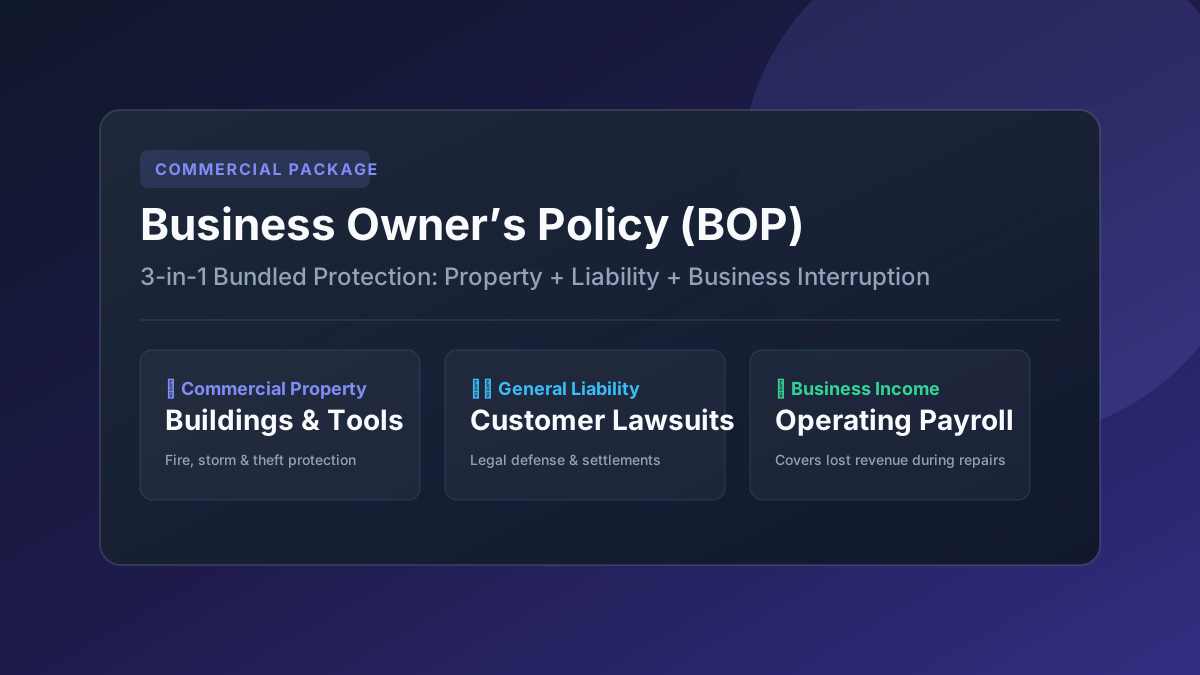
1. What Is a Business Owner’s Policy (BOP)?
For small business owners, purchasing commercial insurance piecemeal can be complex and prohibitively expensive. You need liability insurance so clients can visit your premises, you need property insurance so your computers and inventory are protected from fire and theft, and you need lost-revenue protection if a disaster forces your doors shut.
To streamline this process, the insurance industry created the Business Owner's Policy (BOP). Think of a BOP as the small business equivalent of a homeowners insurance package policy.
Instead of underwriting three separate policies with three different renewal dates and deductibles, a BOP combines the three most essential commercial protections into a single, pre-packaged policy with a 20% to 25% multi-line discount.
2. The 3 Core Pillars of a Business Owner’s Policy
1. Commercial General Liability: Protects your business against customer slip-and-fall injuries, customer property damage, and advertising lawsuits. Standard limits are $1,000,000 per occurrence and $2,000,000 aggregate.
2. Commercial Property Insurance: Protects physical structures owned by your business AND your "Business Personal Property" (BPP). This covers your office computers, inventory stock, display cases, espresso machines, specialized machinery, and office furniture against fire, windstorm, hail, explosion, vandalism, and burglary.
3. Business Income & Extra Expense (Business Interruption): The most overlooked lifeline in commercial insurance. If a grease fire in your restaurant kitchen causes $70,000 in property damage, Commercial Property pays to rebuild the kitchen. But who pays your $6,000/month retail lease rent and key employee payroll while repairs take 3 months? Business Income replaces your verified net income and ongoing operational overhead during reconstruction.
3. Who Qualifies for a Business Owner’s Policy?
Insurance carriers reserve BOP packages for businesses with low-to-moderate physical and operational risk profiles:
| Business Type | BOP Eligibility | Typical Annual Premium | Key Optional Endorsement |
|---|---|---|---|
| Retail Stores (Boutiques, Bookstores) | ✅ High Eligibility | $650 – $1,200 / yr | Inventory Spoilage & Shoplifting |
| Professional Offices (Law, Accounting, Marketing) | ✅ High Eligibility | $500 – $900 / yr | Cyber Liability & Data Breach |
| Cafes & Quick-Serve Restaurants | ✅ Eligible (with kitchen safety) | $1,200 – $2,400 / yr | Equipment Breakdown & Food Spoilage |
| Independent Trade Contractors | ✅ Eligible (Select trades) | $800 – $1,600 / yr | Inland Marine / Tools & Equipment |
| Heavy Industrial / Chemical Manufacturing | ❌ Ineligible (Requires Monoline) | Custom Commercial Package | Pollution & Environmental Liability |
4. Essential Riders to Add to Your BOP
While a baseline BOP provides comprehensive coverage, modern businesses should customize their package with three inexpensive endorsements:
- Cyber Liability & Data Breach ($15–$30/mo): Covers legal defense fees, forensic investigations, and regulatory penalties if customer records, credit cards, or emails are breached.
- Equipment Breakdown ($10/mo): Standard property insurance covers external perils (fire, storms); it excludes electrical short circuits, mechanical motor burnout, or boiler explosions. Equipment Breakdown covers the internal mechanical failure of expensive machinery.
- Hired & Non-Owned Auto (HNOA) ($12/mo): If an employee uses their personal car to pick up office lunch or deposit business checks at the bank and causes a serious collision, your business will be named in the lawsuit. HNOA shields your business entity.
5. Strategic Tactics to Lower Your BOP Premium by 20%
Small business margins are sensitive to operating overhead. To secure the most competitive BOP rating from commercial underwriters:
1. Conduct a Regular Business Personal Property (BPP) Audit: Many business owners continue paying insurance on depreciated computer hardware or sold manufacturing inventory. Auditing your contents schedule annually ensures you only pay for currently operational assets.
2. Implement Formal Risk Mitigation Protocols: Installing UL-listed commercial central station fire alarms, commercial sprinkler systems, security cameras, and documented employee slip-and-fall protocols qualifies your business for discretionary underwriter credits of up to 15%.
3. Adjust Deductibles Strategically: Shifting your property deductible from $500 to $1,500 or $2,500 reduces the property portion of your BOP premium by 12% to 18%, freeing cash flow for marketing and payroll.
Compare Verified Rates in Your State
Benchmark rate filings from Progressive, State Farm, GEICO, Allstate, and Travelers with zero obligation.
Frequently Asked Questions
Q: Does a Business Owner’s Policy include Workers’ Compensation?
No. Workers’ Compensation is governed by statutory state law and cannot be bundled inside a standard BOP. It must be purchased as a dedicated standalone policy.
Q: Can home-based businesses purchase a BOP?
Yes! If you run an e-commerce, consulting, or artisan business from home and hold $25,000+ in inventory or business computers, a home-based BOP is far superior to standard homeowners riders.
Q: How does the insurer calculate Business Income payouts?
The adjuster reviews your previous 12 to 24 months of business tax returns, profit-and-loss (P&L) statements, and point-of-sale records to calculate historical average daily revenue.
Related Authority Insurance Guides
Gap Insurance Explained: When Is It Worth It?
Learn how gap insurance covers vehicle loan depreciation deficits for $30/year.
Limits BaselineHow Much Car Insurance Do I Actually Need?
Why state minimums put your savings at risk and why 100/300/100 is baseline.
Bundling SecretsHome & Auto Bundling: Save 25% on Premiums
Compare multi-line discount tiers across State Farm, Allstate, and Progressive.