Key Takeaways at a Glance
- The Commercial Exclusion: Every standard personal auto policy excludes coverage for commercial livery and delivery driving. Concealing gig work voids your insurance policy.
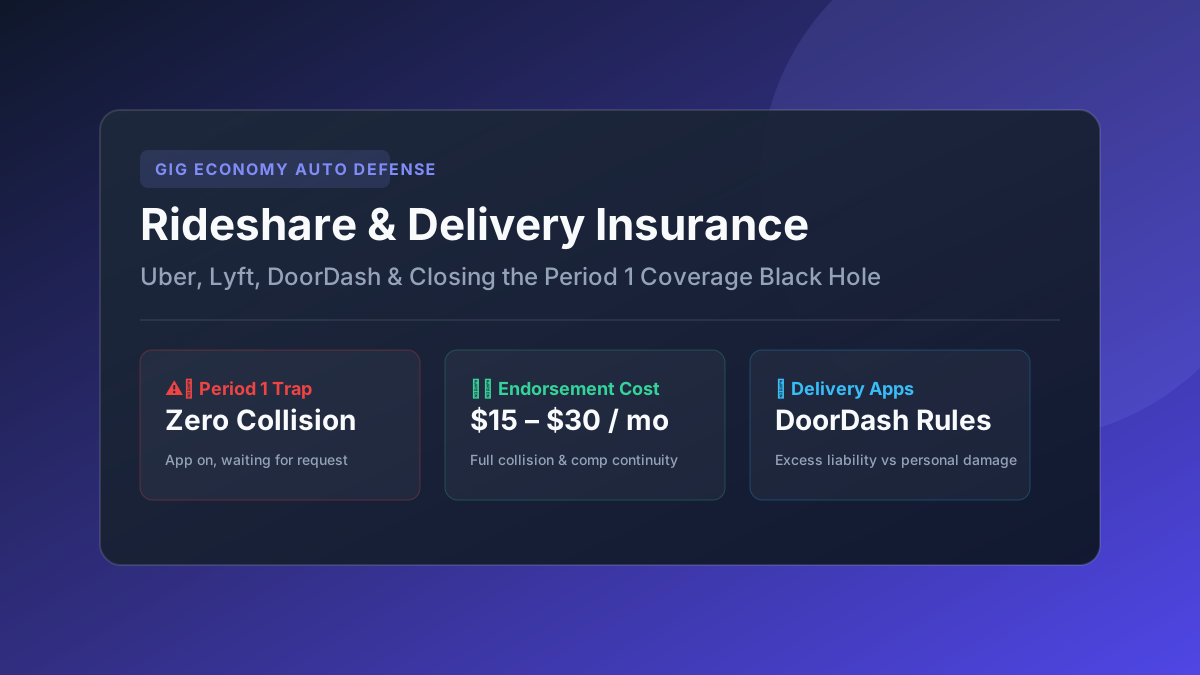
- The Period 1 Vulnerability: While waiting for a ride or order request with the app open, app-provided insurance provides zero collision or comprehensive coverage for your car.
- The Affordable Solution: Adding a Rideshare Endorsement ($15–$35/month) bridges the gap and extends your full collision and comprehensive coverage across all periods.
- Delivery Apps Differ: DoorDash and Grubhub do not provide comprehensive or collision coverage during any delivery phase, making personal endorsements essential.
Calculate Your Total Auto Insurance Rate
Driving extra miles for gig platforms? Use our Auto Insurance Calculator to calculate your monthly premium based on annual mileage, coverage limits, and deductible tiers.
- 1. The 3 Phases of Gig Driving: Where the Coverage Gap Hides
- 2. Period 1: The Multi-Billion Dollar Insurance Trap
- 3. Food Delivery vs. Passenger Rideshare: DoorDash & UberEats Nuances
- 4. The Rideshare Endorsement: What It Covers & Carrier Comparison
- 5. What Happens If You Crash Without an Endorsement?
- Frequently Asked Questions
1. The 3 Phases of Gig Driving: Where the Coverage Gap Hides
Insurance underwriters and transportation network companies (TNCs) divide gig driving into three distinct operational windows. Knowing which window you are in at the exact millisecond of a crash determines whether your claim is approved or denied:
| Driving Period | App Status | Who Covers Liability? | Who Covers Damage to Your Vehicle? |
|---|---|---|---|
| Period 0 | App is OFF (Personal driving) | Your Personal Auto Policy | Your Personal Auto Policy (Collision/Comp) |
| Period 1 | App is ON (Waiting for ride or delivery ping) | Contingent TNC Policy ($50k/$100k/$25k) | ZERO COVERAGE (Complete Denial) |
| Period 2 | Ride or order accepted; en route to pickup | TNC Commercial Policy ($1,000,000) | TNC Contingent Collision ($2,500 Deductible) |
| Period 3 | Passenger in vehicle or food in transit | TNC Commercial Policy ($1,000,000) | TNC Contingent Collision ($2,500 Deductible) |
2. Period 1: The Multi-Billion Dollar Insurance Trap
The most dangerous phase for gig workers is Period 1. You are circling downtown waiting for an Uber ride or idling in a restaurant parking lot waiting for a DoorDash order. If you hit a curb, get rear-ended by an uninsured driver, or cause an accident during this time:
- Your Personal Policy Denies: Under the standard "public or livery conveyance" exclusion, your personal policy pays $0 for bodily injury, property damage, and your vehicle repairs.
- Uber & Lyft Deny Your Car: The platform only provides state-mandated low liability to third parties ($50,000 bodily injury per person, $100,000 per accident, $25,000 property damage). They provide zero collision or comprehensive coverage for your car.
- Out-of-Pocket Total Loss: If your vehicle is totaled, you must pay off your auto loan with your own savings.
3. Food Delivery vs. Passenger Rideshare: DoorDash & UberEats Nuances
Many gig workers assume that food delivery poses lower risk than passenger transport. However, insurance coverage for delivery apps is often more restrictive:
- DoorDash Insurance Policy: DoorDash maintains excess liability insurance for active delivery (Periods 2 & 3). However, DoorDash provides no physical damage coverage for your vehicle under any circumstances. If your car is damaged on a DoorDash run, you are on your own unless you have an endorsement.
- Instacart & Spark: Similar to DoorDash, grocery delivery apps provide third-party liability only while goods are in transit and never cover physical damage to the contractor's vehicle.
- UberEats: Because Uber operates as a unified platform, UberEats provides contingent collision coverage during active delivery, but only if you maintain collision coverage on your personal policy and pay Uber's steep $2,500 deductible.
4. The Rideshare Endorsement: What It Covers & Carrier Comparison
The simplest and most economical solution is to purchase a Rideshare Endorsement (often called a Transportation Network Company or TNC rider) from your personal auto insurer. This endorsement does three critical things:
- Removes the commercial livery exclusion during Period 1.
- Extends your personal collision and comprehensive coverage with your personal deductible ($500 or $1,000) rather than the app's brutal $2,500 deductible.
- Maintains continuous coverage without purchasing an expensive $200–$400/month commercial business auto policy.
Leading carriers offering rideshare endorsements include Progressive, State Farm, Allstate, and USAA, with monthly endorsement fees typically ranging between $15 and $30 per vehicle.
5. What Happens If You Crash Without an Endorsement?
Insurers actively investigate delivery indicators following an accident. Claims adjusters review police reports, examine dashboard phone mounts, check food receipts on front seats, and can subpoena gig platform metadata (Uber and Lyft transmit driver online logs directly during contested liability lawsuits).
If an insurer discovers you were driving for a gig platform without an endorsement, they will deny the claim, issue a formal policy cancellation for material misrepresentation, and report the denial to insurance exchange databases (LexisNexis C.L.U.E.), making it nearly impossible to buy affordable insurance for 3 to 5 years.
Frequently Asked Questions
Does personal auto insurance cover driving for Uber, Lyft, or DoorDash?
No. Standard personal auto policies have an explicit 'livery and commercial transport' exclusion. Driving for rideshare or food delivery without an endorsement will cause your carrier to deny crash claims and cancel your policy for insurance fraud.
What is the Period 1 coverage gap in rideshare insurance?
Period 1 begins when you open the driver app and wait for a ride request. During Period 1, Uber and Lyft provide only low contingent liability ($50k/$100k/$25k) and zero collision or comprehensive damage coverage for your vehicle, while your personal insurer denies coverage completely.
How much does a rideshare endorsement cost on car insurance?
A rideshare endorsement typically costs between $15 and $35 per month (roughly $180 to $400 per year) added to your existing personal auto policy, which is dramatically cheaper than a standalone commercial policy ($200+ per month).