Key Takeaways at a Glance
- The Daily Driver Trap: Adding a classic 1969 Camaro, vintage Porsche 911, or restored Bronco to a standard Geico or State Farm policy values it at depreciated Actual Cash Value (ACV).
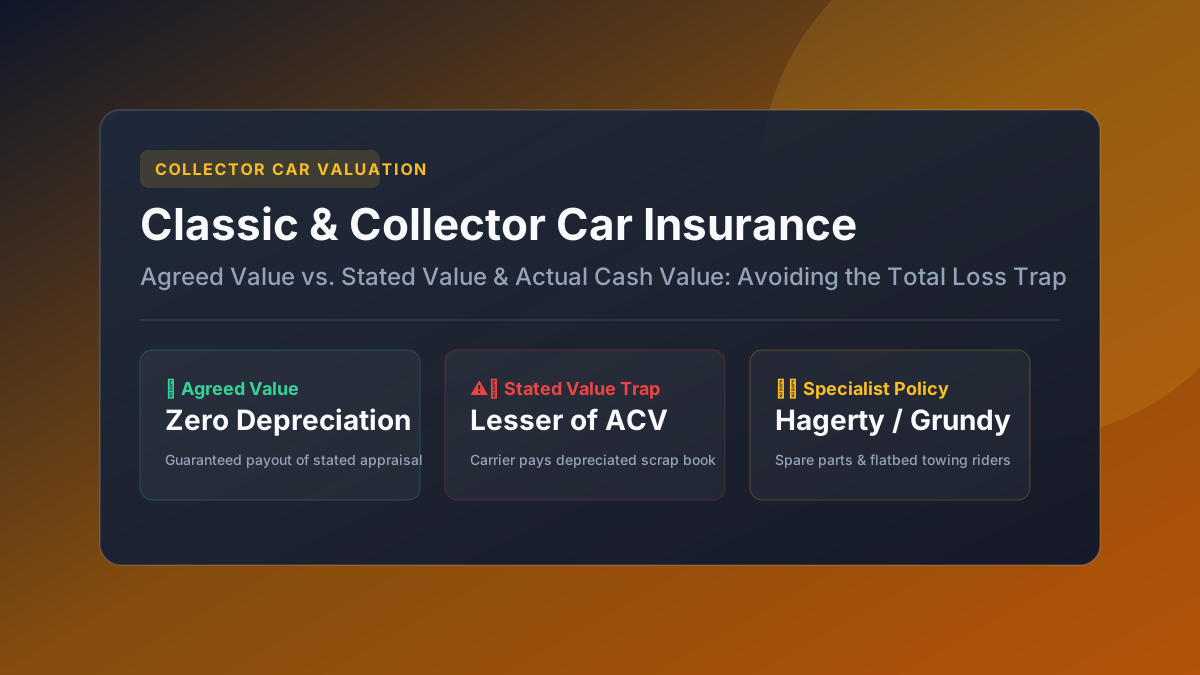
- The Stated Value Loophole: Stated Value policies do NOT guarantee payout. They pay the stated amount OR the actual cash value—whichever is less—protecting the insurer, not you.
- The Agreed Value Guarantee: True collector policies (Hagerty, Grundy) lock in an agreed appraisal. If totaled, you receive a check for the exact full agreed amount with zero depreciation.
- Specialty Perks: Collector insurance includes soft-strap flatbed towing, $2,000–$10,000 in spare parts coverage, and auto-appreciation inflation guards (up to 6% per year).
Estimate Daily Driver vs. Pleasure Vehicle Insurance
Calculate your standard vehicle insurance premiums and see how low annual mileage discounts reduce rates with our Auto Insurance Calculator.
- 1. The 3 Valuation Methods: ACV vs. Stated Value vs. Agreed Value
- 2. The Stated Value Trap: Why Owners Get Burned After a Total Loss
- 3. Strict Collector Underwriting: Garages, Daily Drivers & Mileage Limits
- 4. Critical Specialty Riders: Spare Parts, Flatbed Towing & Car Show Liability
- 5. Hagerty vs. Grundy vs. American Collectors: Head-to-Head Comparison
- Frequently Asked Questions
1. The 3 Valuation Methods: ACV vs. Stated Value vs. Agreed Value
Automobile insurance policies calculate total loss settlement checks using one of three legal contract definitions. For collector, classic, antique, and modified vehicles, selecting the wrong valuation method can cost you tens of thousands of dollars:
| Valuation Form | How Total Loss Payout Is Calculated | Depreciation Applied? | Best For |
|---|---|---|---|
| Actual Cash Value (ACV) | Current market replacement minus physical depreciation, mileage, and wear. | Yes (Heavy) | Modern daily commuters (Camrys, F-150s, Civics) |
| Stated Value (Stated Amount) | Lesser of the stated appraisal amount OR current actual cash value. | Yes (Carrier Discretion) | Commercial work trucks, heavy equipment |
| Agreed Value (Guaranteed) | Contractually fixed agreed dollar amount paid in full upon total loss. | NO (Zero Depreciation) | All Classic, Antique & Collector Cars |
2. The Stated Value Trap: Why Owners Get Burned After a Total Loss
Many classic car owners mistakenly believe they have full protection because they purchased a "Stated Value" policy with a stated limit of $65,000 for their restored 1970 Chevelle SS.
However, look closely at the policy wording. In standard ISO policy language, Stated Value contains a restrictive clause stating: "In the event of theft or total loss, our limit of liability will be the lesser of the Stated Amount or the Actual Cash Value."
The stated amount serves only as a ceiling on what the insurer will pay; it is not a guarantee. After a total fire or crash, the insurance adjuster reviews standard auction salvage tables and determines that an un-restored 1970 Chevelle chassis is only worth $18,000, paying you $18,000 despite your $65,000 stated limit! An Agreed Value policy eliminates the "lesser of" clause and guarantees the full $65,000 check.
3. Strict Collector Underwriting: Garages, Daily Drivers & Mileage Limits
Specialty collector insurance costs 40% to 60% less than daily driver insurance, but carriers enforce strict underwriting covenants:
- Fully Enclosed Garage Requirement: The classic car must be parked inside a locked, fully enclosed residential garage or specialized commercial storage facility when not in use. Carports and driveway parking are grounds for declination.
- Separate Daily Commuter Vehicles: Every licensed driver in your household must own and insure a modern primary vehicle for daily commuting to work or school.
- Pleasure & Club Use Only: Policies permit weekend pleasure cruises, car club rallies, track parade laps, and automotive exhibitions, but strictly forbid commercial use or daily errand running.
4. Critical Specialty Riders: Spare Parts, Flatbed Towing & Car Show Liability
Agreed-value policies from specialty carriers provide unique coverages tailored to the automotive hobbyist that standard auto policies completely ignore:
- Spare Parts & Tools Coverage: Automatically covers $2,000 to $10,000 worth of spare carburetors, chrome trim, original wheels, and restoration tools stored in your garage.
- Guaranteed Soft-Strap Flatbed Towing: Collector cars have low ground clearance and delicate suspension components. Standard tow hooks cause severe undercarriage damage; specialty policies mandate certified soft-strap flatbed transport.
- Cherished Salvage Rights: If your vehicle is totaled, standard insurers seize the title and sell the carcass at auction. Collector policies often allow you to retain the salvage vehicle at zero cost so you can harvest rare parts.
5. Hagerty vs. Grundy vs. American Collectors: Head-to-Head Comparison
The top three underwriters in North America each serve specific niche profiles:
- Hagerty: The largest collector insurer, famous for flexible pleasure driving (no strict odometer caps) and the Hagerty Drivers Club roadside assistance network. Slightly higher premiums, but unmatched claims reputation.
- Grundy Insurance: Renowned for their "Motor Vehicle Program" (MVP), offering agreed-value coverage with zero deductible on comprehensive and collision claims, and unlimited annual pleasure mileage.
- American Collectors Insurance: Offers tiered annual mileage plans (1,000, 2,500, or 5,000 miles/year) that provide the absolute lowest premium rates for museum-quality show cars that rarely leave the garage.
Frequently Asked Questions
What is the difference between Agreed Value and Stated Value car insurance?
Agreed Value guarantees that in the event of a total loss or theft, the insurer pays the exact agreed-upon dollar amount without any depreciation. Stated Value states an appraised amount, but policy language allows the insurer to pay the 'lesser of' the stated amount or the actual cash value (ACV), exposing the owner to severe depreciation deductions.
Can I drive my classic car to work on a collector car policy?
Most collector car policies (Hagerty, Grundy) explicitly prohibit daily commuting to work or school. Coverage is designed for pleasure use, club events, exhibitions, parades, and weekend cruises, and typically requires every licensed household driver to have a separate daily-use vehicle.
Why is classic car insurance so much cheaper than regular car insurance?
Classic car insurance typically costs 40% to 60% less than standard auto insurance because collector cars are driven fewer miles (typically under 2,500–5,000 miles per year), stored in secure enclosed garages, and maintained with exceptional care, resulting in very low crash loss ratios.