Key Takeaways at a Glance
- Collision Covers Moving Impacts: Collision insurance pays when your vehicle hits another vehicle, a guardrail, a tree, or flips over in a rollover.
- Comprehensive Covers "Acts of God": Comprehensive (Other Than Collision) pays for hail, animal strikes (deer), fire, theft, vandalism, glass cracks, and flood.
- The 10% Financial Rule: When the annual cost of comprehensive and collision coverage exceeds 10% of your vehicle’s fair market value, dropping full coverage makes mathematical sense.
- Keep Comprehensive Alone: In many states, you can drop expensive collision coverage while retaining inexpensive ($8–$15/mo) comprehensive coverage to protect against theft and hail.
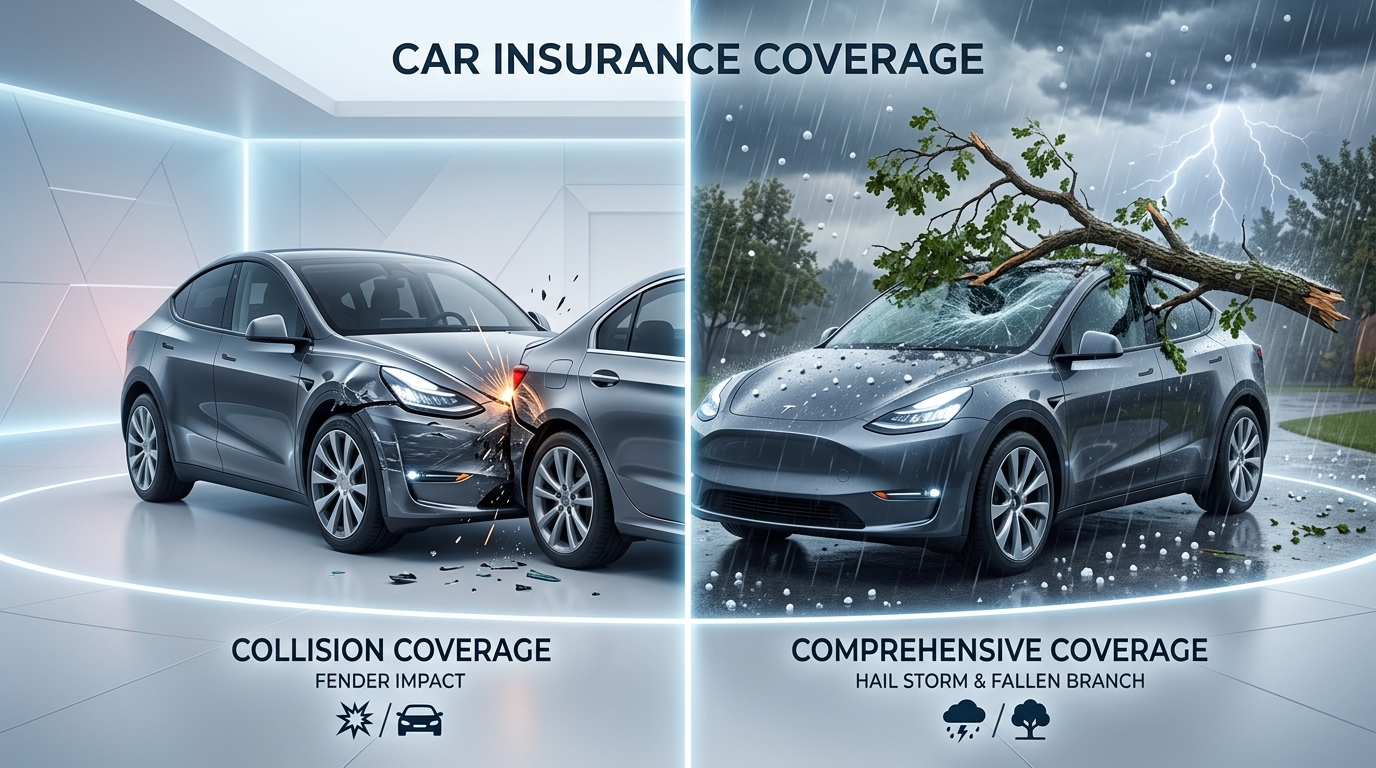
1. What Is the Difference Between Comprehensive and Collision?
Many drivers assume that having "full coverage" means a single magical policy clause that covers any possible damage to their car. In reality, "full coverage" is an informal industry term representing a trio of distinct protections: State-Mandated Liability, Collision Coverage, and Comprehensive Coverage.
While both collision and comprehensive are physical damage coverages that repair or replace your vehicle after a loss, they are triggered by entirely different real-world perils.
Understanding which coverage applies to which scenario prevents unexpected deductible disputes and helps you decide when to remove full coverage from an aging vehicle.
2. Peril-by-Peril Breakdown: Which Coverage Pays?
Here is a quick cheat sheet on how claims are categorized by insurance adjusters:
| Accident or Damage Scenario | Triggered Coverage | At-Fault Impact on Rates | Deductible Applied? |
|---|---|---|---|
| Rear-ending another vehicle at a stoplight | Collision | Yes (At-Fault Surcharge applies) | Yes ($500–$1,000 Collision Deductible) |
| Hitting a deer or large animal on a rural highway | Comprehensive | No (Treated as non-fault Act of God) | Yes ($250–$500 Comp Deductible) |
| Severe hailstorm denting hood, roof, and trunk | Comprehensive | No (Weather event) | Yes (Comprehensive Deductible) |
| Vehicle stolen from driveway overnight | Comprehensive | No (Crime victim) | Yes (Comprehensive Deductible) |
| Backing into a parking lot concrete pole or mailbox | Collision | Yes (Single-vehicle collision) | Yes (Collision Deductible) |
| Pothole destroying wheel rim and suspension axle | Collision | Often considered collision with road surface | Yes (Collision Deductible) |
| Windshield cracked by flying gravel on highway | Comprehensive | No ($0 deductible in FL, KY, SC, AZ) | Yes (Unless zero-glass endorsed) |
3. The 10% Rule: When Should You Drop Full Coverage?
If you lease or finance your vehicle, your lender legally requires you to maintain both comprehensive and collision coverage until the loan is paid in full. But once you hold the vehicle title free and clear, carrying full coverage becomes entirely optional.
To determine if you are wasting money, use the financial planner "10% Rule":
1. Find your vehicle’s current private-party Actual Cash Value (ACV) using Kelley Blue Book (KBB) or Edmunds.
2. Subtract your policy deductibles ($1,000 collision deductible).
3. Calculate the maximum possible payout your insurer would ever write you in a total-loss crash.
4. Look at your declarations page and total your annual comprehensive and collision premiums.
If your annual full coverage premium exceeds 10% of the net total loss payout, cancel collision coverage and divert those dollars into a high-yield savings emergency fund!
4. Mathematical Example: An Aging 2014 Sedan
Consider a driver insuring a 2014 Honda Civic with 145,000 miles:
- Market Value (ACV): $4,500
- Collision Deductible: $1,000
- Maximum Possible Insurance Check in a Total Loss ($4,500 - $1,000): $3,500
- Annual Cost for Comprehensive & Collision: $680 / year
- Math Check: $680 is 19.4% of the maximum $3,500 payout!
In this scenario, the driver is paying nearly 20% of the car's total value every single year just for physical damage coverage. In less than 5 claim-free years, the driver pays the insurer more than the entire car is worth.
5. The Savvy Compromise: Drop Collision, Keep Comprehensive
Many drivers don't realize you can unbundle physical damage coverages. Collision coverage makes up roughly 75% of your physical damage bill because at-fault traffic crashes are common. Comprehensive coverage is remarkably cheap—often just $8 to $15 per month.
Dropping collision saves you $500+ per year, while keeping comprehensive protects you against catalytic converter theft, total vehicle theft, falling oak branches, and cracked windshields.
Compare Verified Rates in Your State
Benchmark rate filings from Progressive, State Farm, GEICO, Allstate, and Travelers with zero obligation.
Frequently Asked Questions
Q: Does collision insurance pay for damage to the other driver’s car?
No. Damage to the other driver's vehicle is paid under your Property Damage Liability coverage. Collision insurance strictly pays to repair YOUR vehicle.
Q: What happens if a deer jumps in front of my car?
Hitting an animal is legally classified as a Comprehensive claim in all 50 states, meaning it will not count as an at-fault accident on your motor vehicle record.
Q: Will my rates go up if I file a comprehensive claim?
Generally no. Comprehensive claims are non-fault events (weather, vandalism, theft) and most states prohibit carriers from adding at-fault surcharges for them.
Related Authority Insurance Guides
Gap Insurance Explained: When Is It Worth It?
Learn how gap insurance covers vehicle loan depreciation deficits for $30/year.
Limits BaselineHow Much Car Insurance Do I Actually Need?
Why state minimums put your savings at risk and why 100/300/100 is baseline.
Bundling SecretsHome & Auto Bundling: Save 25% on Premiums
Compare multi-line discount tiers across State Farm, Allstate, and Progressive.