Key Takeaways at a Glance
- The Paradox of Safety: Advanced Driver Assistance Systems (ADAS) prevent thousands of crashes, yet driving tech has increased collision repair bills by over 38% since 2021.
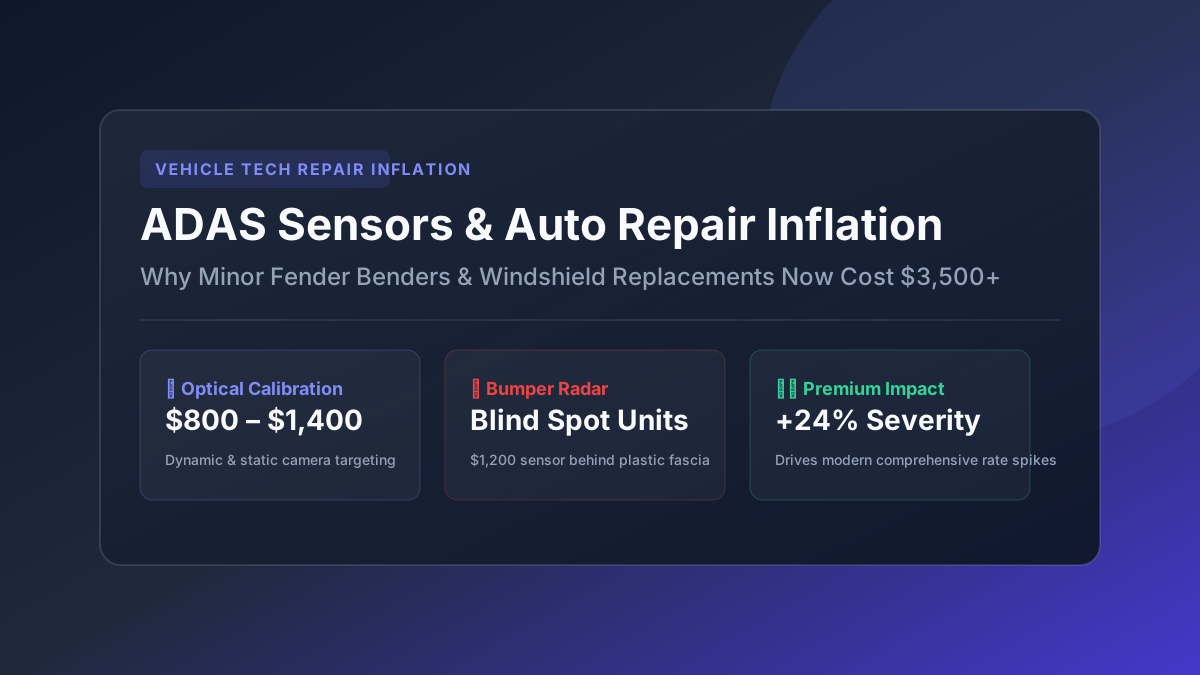
- Windshield Shock: Replacing a cracked windshield on modern vehicles requires forward camera optical calibration ($800–$1,400), turning a $300 job into a $2,200 insurance claim.
- Bumper Vulnerability: Parking sensors, radar units, and blind-spot monitors are housed directly behind thin exterior plastic bumpers, guaranteeing destruction in 5-mph impacts.
- Policy Safeguards: Car owners must ensure their policy has $0 glass deductible riders and OEM (Original Equipment Manufacturer) parts endorsements to prevent out-of-pocket calibration gaps.
Calculate Your Comprehensive & Collision Rate
Insuring a late-model vehicle with automatic emergency braking and radar? Calculate realistic full coverage premiums using our Auto Insurance Calculator.
- 1. What Is ADAS? The Technology Inside Every New Car
- 2. Anatomy of a $3,500 Repair: Windshields, Cameras & Radars
- 3. Static vs. Dynamic Calibration: Why Technicians Charge $200/Hour
- 4. The Underwriter's Dilemma: Lower Crash Frequency vs. Higher Severity
- 5. 3 Essential Insurance Clauses to Add to Your Auto Policy
- Frequently Asked Questions
1. What Is ADAS? The Technology Inside Every New Car
Advanced Driver Assistance Systems (ADAS) encompass the suite of digital vision, radar, and acoustic sensors designed to prevent human driving errors. Standard on over 92% of new vehicles sold in North America, these systems power:
- Forward Collision Warning & Automatic Emergency Braking (AEB): Forward-facing cameras mounted behind the rearview mirror.
- Blind Spot Detection & Rear Cross-Traffic Alert: 24GHz and 77GHz radar sensors housed in rear quarter panels and bumper corners.
- Adaptive Cruise Control: Long-range radar modules positioned directly behind front grille emblems.
- Surround-View Parking Systems: Wide-angle fisheye cameras embedded under side mirrors and trunk lids.
2. Anatomy of a $3,500 Repair: Windshields, Cameras & Radars
Prior to ADAS integration, repairing a cracked windshield or repainting a scratched plastic bumper was an inexpensive cosmetic fix. Today, the physics of sensor alignment have radically inflated repair costs:
| Damage Type | Traditional Repair Cost (2015) | Modern ADAS Repair Cost (2026) | Key Cost Multiplier |
|---|---|---|---|
| Windshield Rock Chip / Crack | $275 – $350 | $1,850 – $2,400 | Acoustic OEM glass + dual forward camera calibration |
| Low-Speed Front Bumper Tap | $500 – $750 | $3,200 – $4,600 | Radar transceiver replacement ($1,200) + aiming brackets |
| Side Mirror Knock-Off | $200 – $300 | $1,400 – $1,900 | Heated mirror with blind spot indicator + 360-cam realignment |
| Rear Bumper Scrape | $450 – $600 | $2,600 – $3,400 | Ultrasonic sonar replacement + blind spot radar calibration |
3. Static vs. Dynamic Calibration: Why Technicians Charge $200/Hour
Sensors must be calibrated with millimeter precision. A camera misaligned by even 1 millimeter will miscalculate distances by 50 feet down the road, causing phantom braking or failing to stop before a pedestrian.
Body shops must perform two distinct calibration procedures:
- Static Calibration: Performed inside a specially equipped level bay with controlled lighting, laser levels, and high-contrast geometric optical targets positioned at exact factory angles.
- Dynamic Calibration: The technician connects an OBD-II diagnostic computer and drives the vehicle on marked highways at specified speeds (typically 45–65 mph) under clear weather conditions for 30 to 45 minutes until the vehicle computer locks optical telemetry.
4. The Underwriter's Dilemma: Lower Crash Frequency vs. Higher Severity
Automakers originally promised that smart cars would dramatically lower car insurance rates because automated emergency braking reduces rear-end collisions by up to 50% (according to Insurance Institute for Highway Safety data).
However, insurance pricing operates on two metrics: Frequency (how often crashes occur) and Severity (how much each crash costs to repair). While crash frequency dropped by 10% to 15%, repair severity surged by nearly 40%. The net effect has been a sustained increase in comprehensive and collision loss ratios, forcing carriers like GEICO, State Farm, and Progressive to raise full-coverage rates across the country.
5. 3 Essential Insurance Clauses to Add to Your Auto Policy
- Full Glass Coverage / $0 Glass Deductible: Available in states like Florida, Kentucky, and South Carolina by law, or as an inexpensive $3–$6/month endorsement in other states. Covers the full $2,000 glass replacement and calibration bill without touching your collision deductible.
- OEM Parts Endorsement: Guarantees that body shops use genuine factory windshields and sensors. Cheap aftermarket optical glass often has microscopic optical distortions that cause camera calibration failures.
- Rental Car Reimbursement ($50+/day limit): ADAS repairs take longer because body shops frequently sublet sensor calibration to specialized technical centers. Standard $30/day rental coverage runs out before modern vehicles are released from repair bays.
Frequently Asked Questions
What is ADAS calibration and why does it cost so much?
ADAS (Advanced Driver Assistance Systems) calibration is the precision realignment of cameras, radars, and ultrasonic sensors that control automatic emergency braking, adaptive cruise control, and lane centering. It requires specialized laser targeting equipment and certified technician labor, typically adding $800 to $1,400 to repair invoices.
Does insurance cover windshield camera recalibration?
Yes, if you maintain comprehensive glass coverage or full collision insurance. Insurers are legally required to restore vehicles to safe pre-loss operating condition, which includes manufacturer-mandated sensor recalibration after glass replacement.
Why are insurance rates higher on cars with advanced safety features?
While safety features decrease crash frequency, they dramatically increase crash severity (the cost per claim). Replacing fragile radar units, laser LIDAR sensors, and ultrasonic modules mounted behind bumper fascias can turn a minor $600 bumper scratch into a $3,500 insurance payout.