Key Takeaways at a Glance
- The #1 Misconception: Standard HO-3 homeowners insurance excludes water damage coming from outside the home or from underground drains.
- Water Backup Rider: Sump pump failure and municipal sewer line backups require an optional endorsement costing only $35 to $65 per year.
- FEMA Flood Insurance: Rising surface water, overflowing creeks, and storm surge can ONLY be insured through FEMA NFIP or private flood policies.
- Finished Basements: Replacing drywall, flooring, electrical, and furniture in a flooded basement averages $25,000 to $45,000 out of pocket without proper riders.
- 1. The Water Dilemma: Why Insurance Denies Most Basement Water Claims
- 2. The 3 Types of Water Damage: Burst Pipe vs Backup vs Flood
- 3. Quick Comparison: What Covers What?
- 4. How Much Water Backup Coverage Should You Buy?
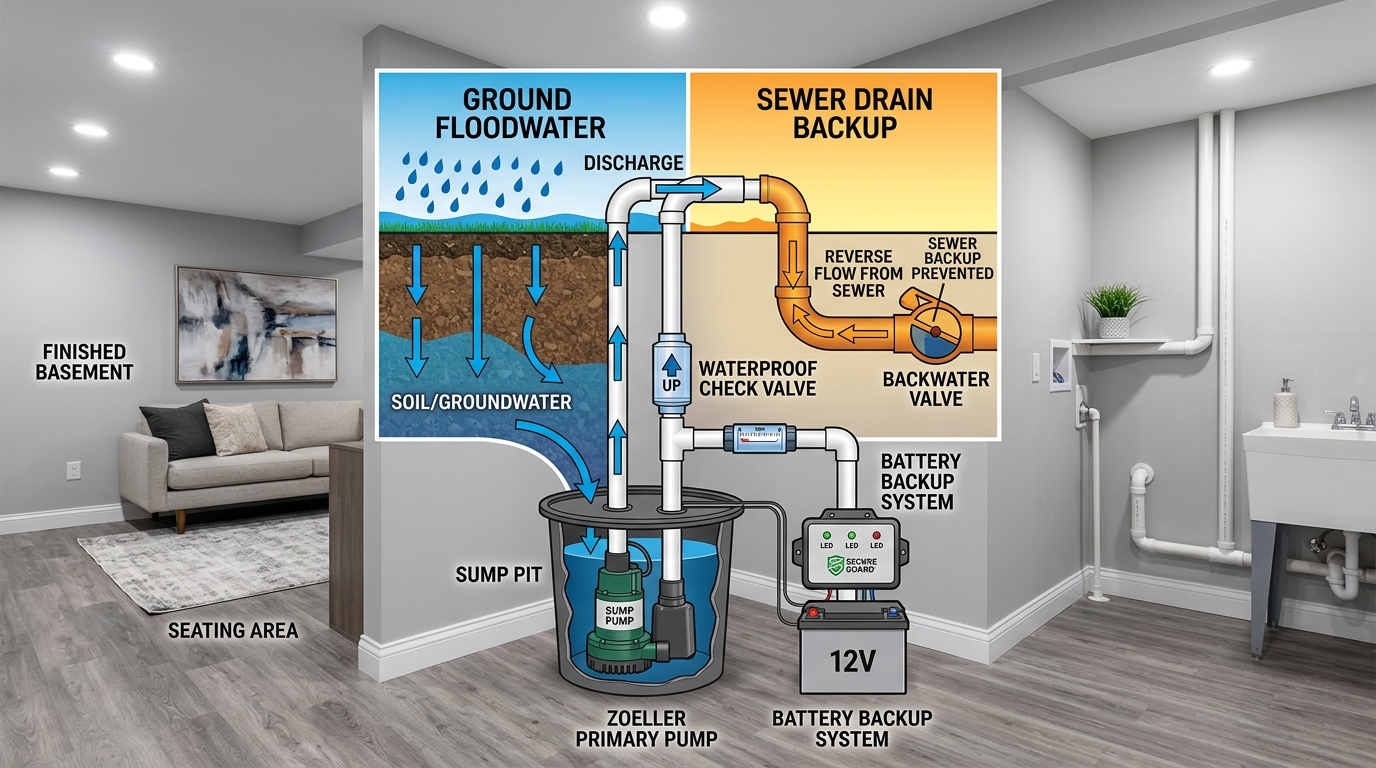
- 5. Mechanical Defenses: Sump Pumps & Backwater Valves
- Frequently Asked Questions
1. The Water Dilemma: Why Insurance Denies Most Basement Water Claims
Water is the single most frequent cause of property damage claims in the United States, accounting for nearly 1 in 4 homeowners insurance claims annually. Yet, it is also the most misunderstood source of claim denials.
When water unexpectedly fills a finished basement or living room, distraught homeowners assume their comprehensive homeowners insurance policy will cover the restoration, drying, and structural repairs.
In reality, standard homeowners policies (HO-3 and HO-5 forms) draw rigid legal distinctions based on the source and direction of the water. If a pipe inside your wall bursts, that is covered. But if water enters from your plumbing drains, sump pit, or across the lawn, standard insurance pays $0 unless you purchased specific optional riders.
2. The 3 Types of Water Damage: Burst Pipe vs Backup vs Flood
1. Sudden & Accidental Internal Discharge (Covered by Base Policy): When a hot water heater tank ruptures, a washing machine supply hose bursts, or a frozen copper pipe splits inside a crawlspace, standard homeowners insurance covers the water extraction, drywall repairs, and damaged furniture (subject to your standard deductible).
2. Water Backup of Sewers & Drains (Requires Endorsement): When a municipal storm sewer overflows into your home’s basement drain, or when your sump pump experiences a mechanical motor failure or loses power during a thunderstorm, this is Water Backup & Sump Overflow. It is strictly excluded unless you endorse your policy with an HO-04-95 rider.
3. Surface Water / Rising Floodwaters (Requires Dedicated Flood Policy): When heavy rain saturates the earth, causes a nearby creek to crest its banks, or sends a sheet of surface runoff flowing through basement windows and patio doors, this is classified as a Flood. Neither your base policy nor your water backup rider will pay a single penny. It can only be covered by a flood policy.
3. Quick Comparison: What Covers What?
Understanding which policy or endorsement triggers for common water disasters:
| Disaster Scenario | Base Homeowners (HO-3) | Water Backup Rider ($50/yr) | Flood Insurance (FEMA NFIP) |
|---|---|---|---|
| Washing machine hose snaps, flooding hallway | ✅ Covered | Not Applicable | Excluded |
| Sump pump fails during power outage; basement fills | ❌ Excluded | ✅ Covered (up to limit) | ❌ Excluded |
| City sewer line clogs; sewage bubbles up in toilet | ❌ Excluded | ✅ Covered (up to limit) | ❌ Excluded |
| River overflows and submerges ground floor | ❌ Excluded | ❌ Excluded | ✅ Covered (up to $250k) |
| Heavy rain pools on lawn and seeps through foundation | ❌ Excluded | ❌ Excluded | ✅ Covered (2+ acres rule) |
| Tree falls on roof during rain, water pours in | ✅ Covered (Wind/storm) | Not Applicable | Excluded |
4. How Much Water Backup Coverage Should You Buy?
Most insurance carriers default to an introductory $5,000 water backup limit when policyholders check the endorsement box. In 2026, a $5,000 limit is drastically inadequate.
Professional mold remediation and industrial drying fans alone cost $3,500 to $6,000 before drywall replacement begins. If you have a finished basement with bedrooms, a home theater, or bathroom fixtures, you should carry at least $20,000 to $25,000 in Water Backup coverage.
Upgrading from a $5,000 limit to a $25,000 limit typically costs only $25 to $35 more per year—less than $3 per month.
5. Mechanical Defenses: Sump Pumps & Backwater Valves
To prevent claims and qualify for premium discounts, install physical defense hardware: install a battery-backup secondary sump pump that operates during electrical power failures, install a dual-flap backwater valve on your main sewer lateral, and test your sump pump float switch each spring.
Compare Verified Rates in Your State
Benchmark rate filings from Progressive, State Farm, GEICO, Allstate, and Travelers with zero obligation.
Frequently Asked Questions
Q: Does water backup coverage have a separate deductible?
In most policies, water backup claims are subject to your standard all-peril deductible ($1,000 or $1,500), though some carriers have a specific $500 or $1,000 water backup deductible.
Q: Can I buy flood insurance if I do not live in a high-risk flood zone?
Yes! In fact, over 25% of all National Flood Insurance Program (NFIP) flood claims occur in moderate-to-low risk zones (Zones X). Low-risk homeowners qualify for preferred-risk policies starting around $450 to $700 per year.
Q: Does water backup cover sewage cleanup?
Yes. Water backup endorsements cover professional hazardous sewage extraction, antimicrobial chemical sanitation, and replacing contaminated porous flooring and drywall.
Related Authority Insurance Guides
Gap Insurance Explained: When Is It Worth It?
Learn how gap insurance covers vehicle loan depreciation deficits for $30/year.
Limits BaselineHow Much Car Insurance Do I Actually Need?
Why state minimums put your savings at risk and why 100/300/100 is baseline.
Bundling SecretsHome & Auto Bundling: Save 25% on Premiums
Compare multi-line discount tiers across State Farm, Allstate, and Progressive.