Key Takeaways at a Glance
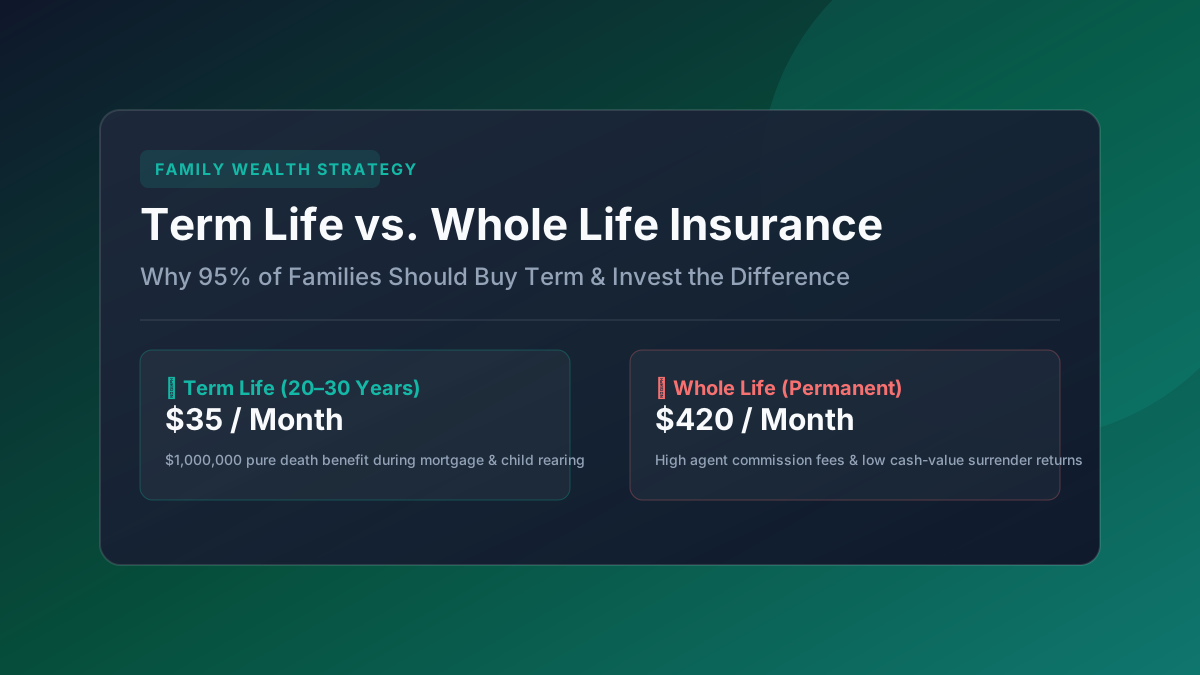
- The 10x Price Differential: A healthy 35-year-old can buy a $1,000,000 20-year term policy for approximately $35/month; an identical whole life policy costs $420+/month.
- Temporary Need vs. Permanent Cost: Life insurance is designed to replace your human economic income during your working and child-rearing years, not to serve as an inefficient investment.
- The Agent Commission Conflict: Whole life insurance pays insurance agents commissions up to 80% to 100% of the first year’s premium, driving aggressive sales pitches.
- Buy Term and Invest the Difference: Putting $385/month in low-cost S&P 500 index funds produces vastly superior wealth over 30 years compared to whole life cash value accounts.
Calculate Your Term vs. Whole Life Needs
Not sure how much coverage your family requires? Use our Free Online Life Insurance Calculator to determine your death benefit with the DIME method and compare level term vs. permanent cash value rate benchmarks in seconds.
- 1. The Core Debate: Pure Protection vs. Investment Hybrid
- 2. Term Life Insurance: Pure Economic Income Replacement
- 3. Whole Life Insurance: The High-Cost Permanent Hybrid
- 4. The 30-Year Wealth Comparison: Term + Invest vs. Whole Life
- 5. The Rare 5%: When Does Whole Life Make Sense?
- 6. The Term Laddering Strategy: Maximizing Protection While Minimizing Cost
- Frequently Asked Questions
1. The Core Debate: Pure Protection vs. Investment Hybrid
No topic in personal financial planning generates as much fierce debate as the battle between Term Life Insurance and Whole Life Insurance.
Aggressive sales pitches on social media tout whole life and Indexed Universal Life (IUL) policies as "tax-free wealth building," "infinite banking," and "be your own bank." Glossy brochures show compounding cash value and loan features.
Yet, independent fee-only financial planners and fiduciary advisors overwhelmingly recommend term life insurance for 95% of American households. Understanding the structural mathematics behind both policies empowers you to avoid paying thousands in unnecessary fees.
2. Term Life Insurance: Pure Economic Income Replacement
Term life insurance is pure risk protection. You select a coverage amount (such as $1,000,000) and a term length (typically 10, 20, or 30 years). You pay a level, locked-in monthly premium.
If you pass away during the active term, the insurance company writes a 100% tax-free death benefit check directly to your designated beneficiaries (your spouse and children). If you outlive the 20- or 30-year term, the policy quietly expires.
Crucially, by the time a 30-year term expires, your children are grown and financially independent, your home mortgage is largely paid off, and your retirement accounts have accumulated substantial wealth, meaning your family no longer suffers catastrophic economic ruin if you pass away.
3. Whole Life Insurance: The High-Cost Permanent Hybrid
Whole life insurance is permanent insurance that remains active until you reach age 100 or 121, provided premiums are paid. It pairs a death benefit with an internal tax-deferred savings component known as "Cash Value."
A portion of your monthly premium pays the true cost of insurance, another portion pays administrative fees and executive overhead, and the remainder accumulates cash value based on carrier dividends.
However, whole life policies suffer from three severe mathematical drawbacks: high early surrender penalties (canceling within the first 3 to 5 years yields $0 in cash value), mediocre historical investment returns (averaging 2% to 4% net of fees), and the forfeiture rule: when you die, the insurer pays your family the death benefit and keeps your accumulated cash value!
4. The 30-Year Wealth Comparison: Term + Invest vs. Whole Life
Consider a healthy 30-year-old male with a $500 monthly life insurance budget over a 30-year horizon:
| Strategy | Monthly Outlay | Death Benefit Protection | Accumulated Wealth at Age 60 (7% Index Return) | Verdict |
|---|---|---|---|---|
| Buy Whole Life Policy | $500 / month | $500,000 Permanent | ~$265,000 (Guaranteed Cash Value) | High fees, low flexibility, surrendered value. |
| Buy Term ($1M) + Invest Difference | $35/mo (Term) + $465/mo (S&P 500 Index) | $1,000,000 (2x Coverage!) | $567,000+ Liquid Cash in Index Fund | Winner. $300k more wealth + double initial protection! |
5. The Rare 5%: When Does Whole Life Make Sense?
Whole life insurance does serve legitimate purposes in specific, narrow wealth planning scenarios: high-net-worth families facing federal estate taxes (utilizing Irrevocable Life Insurance Trusts), families with special needs adult children requiring lifelong care, and complex business partnership buy-sell agreements.
6. The Term Laddering Strategy: Maximizing Protection While Minimizing Cost
Instead of buying a single massive 30-year policy, smart financial planners use the Term Laddering Strategy:
- Tier 1: $500,000 30-Year Term: Locks in core baseline protection to cover your full 30-year home mortgage amortization.
- Tier 2: $500,000 20-Year Term: Protects your family during peak child-rearing and income dependency years until children finish university.
- Tier 3: $500,000 10-Year Term: Provides massive extra liquidity during your thirties when consumer debt is highest and emergency savings are smallest.
By stacking term tiers, you carry $1.5 Million in coverage during your highest-risk years for less than $60/month. As debt decreases and children become self-sufficient, tiers expire naturally, automatically reducing your monthly expenses!
Compare Verified Rates in Your State
Benchmark rate filings from Progressive, State Farm, GEICO, Allstate, and Travelers with zero obligation.
Frequently Asked Questions
Q: Can I convert my term life policy to whole life later?
Yes! Most top-tier term policies include a "Term Conversion Rider" that allows you to convert your term policy into permanent whole life without taking a medical exam or proving good health.
Q: Is the death benefit from term life insurance taxable to my beneficiaries?
No. Under Internal Revenue Code Section 101(a), life insurance death benefit proceeds paid to beneficiaries are generally 100% exempt from federal income tax.
Q: How much life insurance coverage should I buy?
The general rule of thumb recommended by fiduciary financial planners is 10 to 12 times your gross annual income, plus enough to pay off your mortgage balance.
Related Authority Insurance Guides
Gap Insurance Explained: When Is It Worth It?
Learn how gap insurance covers vehicle loan depreciation deficits for $30/year.
Limits BaselineHow Much Car Insurance Do I Actually Need?
Why state minimums put your savings at risk and why 100/300/100 is baseline.
Bundling SecretsHome & Auto Bundling: Save 25% on Premiums
Compare multi-line discount tiers across State Farm, Allstate, and Progressive.