Key Takeaways at a Glance
- SR-22 Is a Certificate, Not a Policy: An SR-22 is not an insurance policy; it is an official certificate of financial responsibility your insurer files electronically with the state DMV.
- The Filing Fee vs. Surcharge: The one-time state filing fee is negligible ($15 to $50). The real cost is the 40% to 100% risk surcharge on your underlying auto insurance policy.
- The Non-Owner SR-22 Hack: If you don't own a vehicle but need your driver’s license reinstated, a "Non-Owner SR-22 Policy" is the cheapest way to fulfill the mandate ($30–$55/month).
- Zero Lapse Tolerance: If your insurance cancels or lapses even for one day, your insurer is legally required to file an SR-26 form, immediately suspending your driver’s license.
1. What Exactly Is an SR-22?
If you have recently had your driver’s license suspended or revoked following a serious driving infraction, the court or state Department of Motor Vehicles (DMV) likely informed you that you must obtain an "SR-22" before your driving privileges can be reinstated.
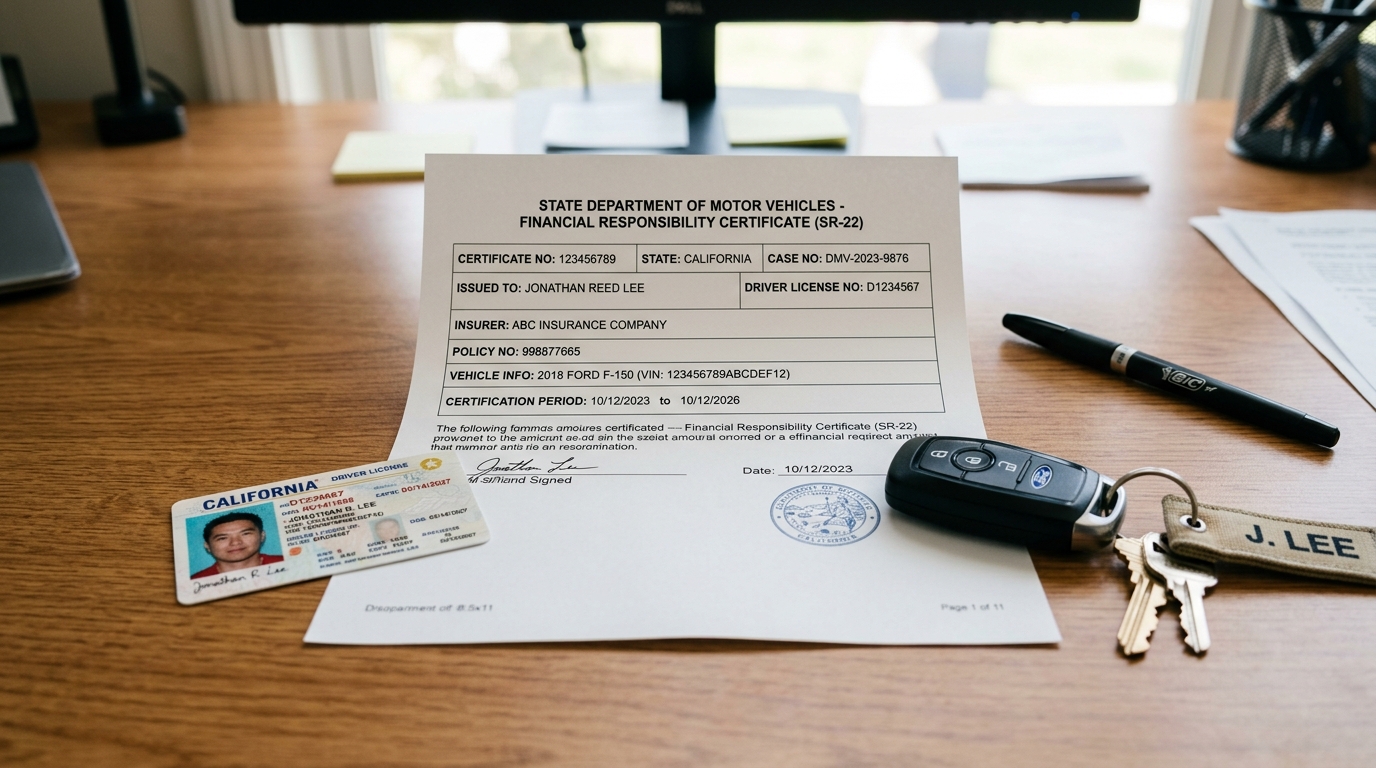
There is widespread confusion about what this term means. An SR-22 is not a type of auto insurance policy. It is an official paper and electronic endorsement—a Certificate of Financial Responsibility—that an auto insurance company files directly with your state motor vehicle licensing agency.
The certificate acts as a legal guarantee to the state government that you have active liability insurance meeting or exceeding the statutory legal minimums. Crucially, the SR-22 agreement requires the insurer to immediately notify the DMV (via an SR-26 form) the moment your policy cancels, lapses, or terminates for any reason.
2. Common Triggers That Require an SR-22 Filing
State courts and licensing bureaus mandate SR-22 certificates for high-risk driving categories:
- Conviction for Driving Under the Influence (DUI / DWI / OWI).
- Driving without active auto insurance (or caught involved in an accident while uninsured).
- Accumulating excessive moving violation points on your driving record within a 12-month period.
- Reckless, careless, or negligent driving convictions.
- Reinstatement following a court-ordered license suspension or revocation.
- Unpaid court civil judgments arising from an at-fault car accident.
3. SR-22 vs. FR-44: Understanding Florida & Virginia Rules
While 48 states utilize the standard SR-22 form, Florida and Virginia enforce a much stricter requirement known as the FR-44 specifically for alcohol- and drug-related offenses:
| Metric | Standard SR-22 Certificate | FR-44 Certificate (FL & VA Only) |
|---|---|---|
| Offense Triggers | Driving uninsured, point accumulation, suspensions | Strictly alcohol/drug DUI / DWI convictions |
| Required Liability Limits | State Minimums (e.g. 25/50/25) | 3x–4x Minimums (100k/300k BI & 50k Property) |
| Premium Payment Rule | Standard monthly billing allowed | Carrier may mandate full 6-month or 1-year payment upfront |
| Cost Impact | Moderate to High (+40% to +80%) | Severe (+100% to +250% due to mandatory high limits) |
| Duration Mandate | Typically 3 Consecutive Years | Typically 3 Consecutive Years without lapse |
4. The Non-Owner SR-22 Strategy for Drivers Without a Car
Many drivers who have had their licenses suspended sell their vehicle or don't currently own a car. However, the state will not restore your driver’s license until you submit proof of an active SR-22.
You cannot buy a standard car insurance policy without a registered vehicle. The solution is a Non-Owner SR-22 Insurance Policy.
A non-owner policy provides secondary liability coverage when you drive rented or borrowed vehicles. Because it does not cover comprehensive or collision damage on a specific automobile, non-owner insurance is remarkably inexpensive—costing between $35 and $65 per month. It satisfies all DMV requirements and allows you to regain a valid, unrestricted driver's license.
5. How Long Must You Maintain an SR-22 & How to Exit the Program
In most states, the statutory SR-22 requirement lasts for exactly 3 consecutive years (36 months) from the date of license reinstatement.
Set up automatic bank drafting (EFT) to ensure your payments never fail. If a payment is returned and the insurer issues an SR-26 cancellation to the DMV, your driver’s license will be immediately suspended, and the state may reset your 3-year clock back to Day 1.
Once you complete your 36 months, contact the DMV to verify your requirement has expired. Then call your insurer to remove the SR-22 filing endorsement and enjoy lower standard rates!
Compare Verified Rates in Your State
Benchmark rate filings from Progressive, State Farm, GEICO, Allstate, and Travelers with zero obligation.
Frequently Asked Questions
Q: Does every insurance company offer SR-22 filings?
No. Preferred-tier carriers may non-renew policyholders who require an SR-22. Non-standard and specialized carriers (like Progressive, Dairyland, The General, and Bristol West) specialize in fast electronic SR-22 filings.
Q: How fast can an SR-22 be submitted to the DMV?
Most carriers file SR-22 forms electronically with your state Department of Motor Vehicles within 24 to 72 hours, allowing you to reinstate your license quickly.
Q: Can I cancel my SR-22 if I move to another state?
No. Moving to a new state does not release you from the originating state’s legal mandate. You must purchase an out-of-state SR-22 policy to fulfill the original state’s requirements.
Related Authority Insurance Guides
Gap Insurance Explained: When Is It Worth It?
Learn how gap insurance covers vehicle loan depreciation deficits for $30/year.
Limits BaselineHow Much Car Insurance Do I Actually Need?
Why state minimums put your savings at risk and why 100/300/100 is baseline.
Bundling SecretsHome & Auto Bundling: Save 25% on Premiums
Compare multi-line discount tiers across State Farm, Allstate, and Progressive.