Key Takeaways at a Glance
- The Tradeoff: PPO plans offer higher monthly payroll premiums in exchange for flat copays; HDHP plans offer lower monthly premiums but require you to pay full negotiated rates until meeting a high deductible.
- The HSA Superpower: HDHP enrollment unlocks access to a Health Savings Account (HSA), the only financial instrument in America with a triple tax advantage.
- The Break-Even Formula: Calculate annual premium savings + employer HSA contributions. If healthy, an HDHP mathematically beats a PPO by $1,200 to $2,500 every single year.
- Out-of-Pocket Maximum Protection: In a catastrophic medical emergency, both HDHP and PPO plans cap your maximum annual financial risk at statutory legal thresholds.
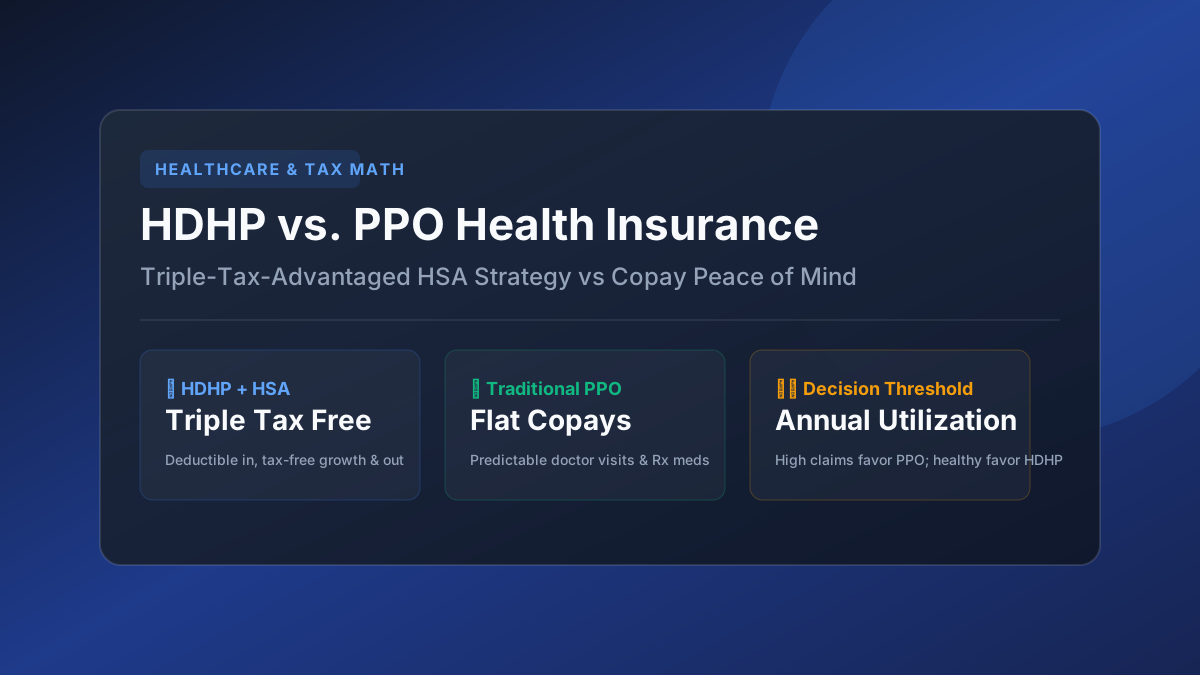
1. The Open Enrollment Dilemma: PPO Comfort vs. HDHP Savings
Every autumn during employer benefits Open Enrollment or ACA marketplace renewals, millions of American workers stare at a benefits comparison table and face the exact same dilemma: Should I stick with the familiar, comfortable PPO, or should I switch to a High Deductible Health Plan (HDHP) with an HSA?
Human psychology strongly favors the PPO. People like the comfort of knowing that an urgent care visit costs a flat $30 copay and an ear infection prescription costs $15. The thought of a $3,500 high deductible feels intimidating.
However, when you analyze total annual costs (payroll premium deductions PLUS out-of-pocket medical expenses), an HDHP paired with an active Health Savings Account is mathematically superior for a large majority of healthy individuals and active families.
2. How HDHPs and PPOs Actually Work
Preferred Provider Organization (PPO): You pay high monthly payroll premiums deducted from every paycheck. In exchange, the insurance company pays its share immediately for doctor visits and prescriptions, requiring only a modest fixed copay ($25–$50). If you have chronic conditions requiring weekly physical therapy or multiple brand-name medications, a PPO provides cash-flow predictability.
High Deductible Health Plan (HDHP): You pay significantly lower monthly payroll premiums, keeping an extra $100 to $250 in every monthly paycheck. However, you do not receive copays. You must pay 100% of the insurer's negotiated contracted rate for doctor visits, labs, and medications until you satisfy your annual deductible ($1,650 individual / $3,300 family minimum in 2026). Once met, the plan shifts to coinsurance (typically 80/20) until you reach the Out-of-Pocket Maximum.
3. The HSA Superpower: The Triple Tax Advantage
The single greatest advantage of an HDHP is eligibility for a Health Savings Account (HSA). No 401(k), Traditional IRA, or Roth IRA can match the tax efficiency of an HSA:
1. Tax-Deductible Going In: Contributions made through employer payroll are 100% pre-tax, exempt from federal income tax, state income tax, AND 7.65% FICA payroll taxes.
2. Tax-Free Growth: You can invest your HSA balance into low-cost S&P 500 index funds. All capital gains, dividends, and interest compound completely tax-free.
3. Tax-Free Coming Out: Withdrawals used for qualified medical, dental, vision, or mental health expenses are 100% tax-free at any age.
4. The "Stealth IRA" Feature: After age 65, you can withdraw funds for any non-medical reason penalty-free (paying only ordinary income tax, exactly like a 401(k)), while retaining tax-free status for healthcare.
4. Real-World Annual Math Comparison
Consider an employee choosing between a corporate PPO and an HDHP with an employer HSA seed:
| Plan Feature | Traditional PPO Plan | HDHP + HSA Plan | HDHP Mathematical Advantage |
|---|---|---|---|
| Annual Employee Payroll Premiums | $3,600 / year ($300/mo) | $1,440 / year ($120/mo) | +$2,160 Premium Savings |
| Employer HSA Contribution Seed | $0 | +$750 (Free employer cash) | +$750 Free Company Money |
| Total Guaranteed Annual Savings | $0 Baseline | +$2,910 Guaranteed Margin | HDHP is $2,910 ahead on Day 1! |
| Annual Deductible | $750 Individual | $2,500 Individual | HDHP requires $1,750 higher deductible |
| Out-of-Pocket Maximum | $4,500 Individual | $5,000 Individual | Only $500 difference in worst-case scenario! |
5. The Decision Rule: Which One Should You Choose?
- Choose the HDHP if: You are generally healthy, visit the doctor 1 to 4 times a year, want to build long-term tax-sheltered wealth, or your employer offers an upfront HSA contribution.
- Choose the PPO if: You have planned surgeries, are pregnant and expecting a baby this policy year, require frequent brand-name specialty prescription drugs, or have anxiety about variable medical invoices.
Compare Verified Rates in Your State
Benchmark rate filings from Progressive, State Farm, GEICO, Allstate, and Travelers with zero obligation.
Frequently Asked Questions
Q: Does an HSA expire at the end of the year like an FSA?
No! Flexible Spending Accounts (FSAs) have a "use-it-or-lose-it" rule. Health Savings Accounts (HSAs) belong to YOU permanently. Your funds roll over forever and move with you if you change jobs.
Q: Are annual preventive checkups free on an HDHP?
Yes! Under the Affordable Care Act (ACA), annual well-woman visits, routine physicals, pediatric vaccinations, and mammograms are 100% covered with $0 out of pocket, even before you meet your deductible.
Q: Can I invest my HSA money in the stock market?
Yes. Top HSA custodians (like Fidelity and Lively) allow you to invest 100% of your HSA contributions into index mutual funds, ETFs, and stocks with zero administrative fees.
Related Authority Insurance Guides
Gap Insurance Explained: When Is It Worth It?
Learn how gap insurance covers vehicle loan depreciation deficits for $30/year.
Limits BaselineHow Much Car Insurance Do I Actually Need?
Why state minimums put your savings at risk and why 100/300/100 is baseline.
Bundling SecretsHome & Auto Bundling: Save 25% on Premiums
Compare multi-line discount tiers across State Farm, Allstate, and Progressive.