Key Takeaways at a Glance
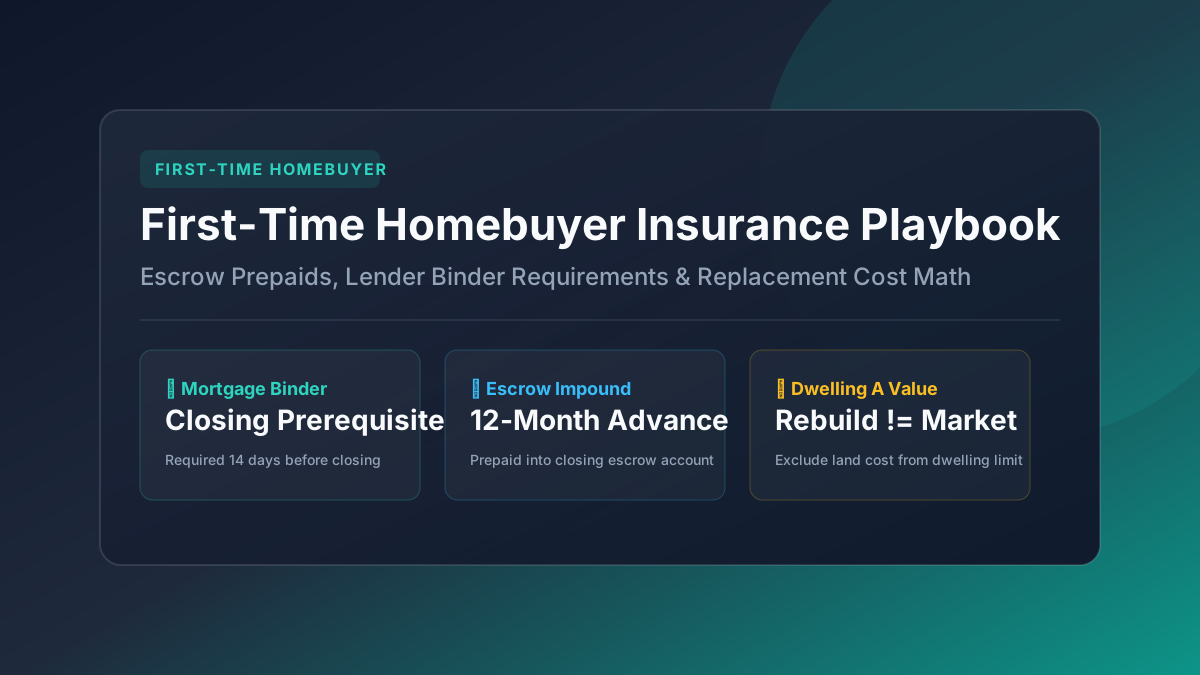
- Lender Binder Deadlines: Your mortgage underwriter requires an approved "Insurance Binder" and Paid Receipt at least 10 to 14 days prior to loan closing.
- The Escrow Impound Account: At closing, your lender collects 12 months of insurance in advance, plus a 2-month cushion, rolling future payments into your monthly mortgage.
- Rebuild Cost vs. Market Value: Never insure your home for its purchase price or Zillow value. You only insure the structural replacement cost, excluding the value of the land.
- CLUE Property History Check: Always request a Comprehensive Loss Underwriting Exchange (CLUE) report on the home during your inspection period to uncover past water or roof claims.
Estimate Your First-Year Homeowners Insurance Premium
Need to verify what escrow impound payment to budget for your mortgage closing? Use our Homeowners Insurance Calculator & House Insurance Estimator to simulate replacement cost figures, roof surcharges, and estimated monthly payments.
1. The Closing Day Surprise: Why Insurance Stalls Home Closings
Purchasing your first home is an exciting milestone filled with home tours, mortgage pre-approvals, home inspections, and escrow paperwork. However, one of the most common reasons mortgage loan closings get delayed at the 11th hour is a last-minute scramble over homeowners hazard insurance.
Mortgage lenders (whether Conventional, FHA, VA, or USDA) will not release funding or issue a "Clear to Close" until they have an approved Insurance Binder and a Paid Receipt showing hazard insurance is active starting on the day of deed recording.
Furthermore, in today's volatile property insurance market, certain homes—especially those with older roofs, knob-and-tube wiring, polybutylene plumbing, or located near wildfire brushes—can fail insurance underwriting inspections, suddenly leaving the buyer unable to secure a policy.
2. The Golden Rule: Rebuild Cost vs. Real Estate Purchase Price
The single most common mistake first-time homebuyers make is confusing their home’s Purchase Price with its Insured Dwelling Limit (Coverage A).
Consider a home purchased for $650,000 in an urban California or Seattle suburb: $280,000 of that purchase price represents the land and dirt value. If the home burns down in a total loss fire, the land does not burn down. The dirt is still there.
Insurance strictly covers the structural reconstruction cost: foundation, framing, siding, roofing, drywall, electrical, plumbing, and fixtures. If reconstructing the home costs $380,000, your Coverage A limit should be set at $380,000, NOT $650,000. Insuring the full real estate market price wastes hundreds of dollars annually paying for phantom land coverage!
3. How Mortgage Escrow Handles Your Insurance Payments
First-time buyers often ask: "Do I write a check to the insurance company every month, or does my bank pay it?"
In 90% of residential mortgages, insurance is handled through an Escrow Impound Account:
| Closing / Monthly Stage | What Happens | Who Pays What | Where the Money Goes |
|---|---|---|---|
| At the Closing Table | 1 Year Prepaid in Full | Buyer pays via closing cash-to-close | Sent directly to insurer to bind Year 1 policy. |
| Escrow Cushion Reserve | 2 Months Extra Prepaid | Buyer deposits into escrow account | Held as reserve against future rate hikes. |
| Monthly Mortgage Check | 1/12th of Annual Premium | Included in monthly PITI mortgage check | Accumulates in lender escrow impound account. |
| Annual Renewal (Year 2+) | Lender pays insurer automatically | Mortgage servicer pays directly | Zero action required from homeowner. |
4. The First-Time Homebuyer Insurance Checklist
1. Pull the CLUE Property Report During Inspection Contingency: Ask the seller for a 5-year CLUE (Comprehensive Loss Underwriting Exchange) report. If the home had two major water claims in 2023, insurers may surcharge your rate by 30% or decline coverage entirely.
2. Shop for Quotes 30 Days Prior to Closing: Never wait until the week of closing. Begin shopping quotes the moment your purchase offer is accepted.
3. Demand Water Backup & Sewer Overflow: Lenders only require basic hazard coverage (fire and wind). Always manually add a $20,000 Water Backup rider to protect your basement and plumbing fixtures.
4. Check Flood Zone Maps (FEMA FIRM): If the property sits in a Special Flood Hazard Area (Zone A or V), your lender will legally mandate flood insurance, which can add $1,500 to $4,000/year to your housing budget.
5. Bundle Your Auto Insurance Immediately: Applying your auto policy to your new home carrier unlocks an immediate 15% to 25% multi-policy discount, saving you $400 to $900 annually.
Compare Verified Rates in Your State
Benchmark rate filings from Progressive, State Farm, GEICO, Allstate, and Travelers with zero obligation.
Frequently Asked Questions
Q: What is an Insurance Binder in a home purchase?
An Insurance Binder is a temporary legal contract issued by your insurance carrier that proves to your mortgage lender that full property coverage is bound and active starting on closing day.
Q: Can I change my homeowners insurance company if I have an escrow account?
Yes, anytime! You are never locked in. You can switch insurers mid-year; your new carrier will notify your mortgage servicer, and your old carrier will send you a prorated refund check for the unused escrow premium.
Q: What does "PITI" stand for in my monthly mortgage payment?
PITI stands for Principal, Interest, Taxes, and Insurance. It represents your all-inclusive monthly housing payment.
Related Authority Insurance Guides
Gap Insurance Explained: When Is It Worth It?
Learn how gap insurance covers vehicle loan depreciation deficits for $30/year.
Limits BaselineHow Much Car Insurance Do I Actually Need?
Why state minimums put your savings at risk and why 100/300/100 is baseline.
Bundling SecretsHome & Auto Bundling: Save 25% on Premiums
Compare multi-line discount tiers across State Farm, Allstate, and Progressive.