Executive Summary: 2026 Actuarial Findings
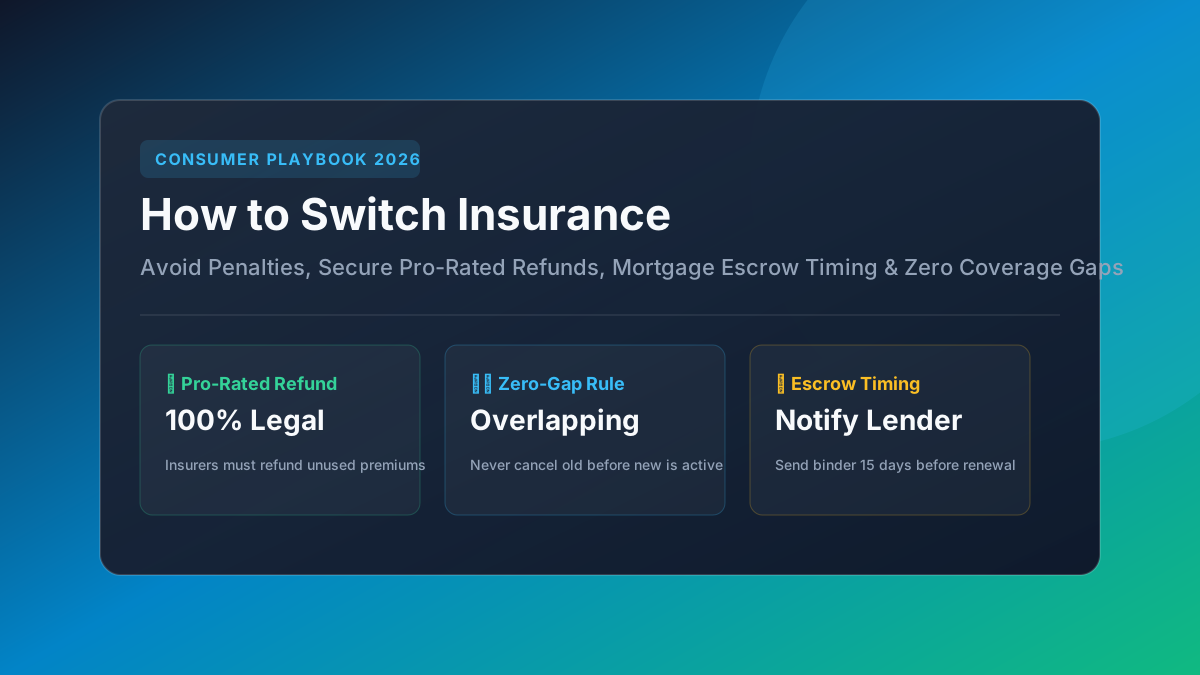
- You Can Switch Anytime: You do NOT have to wait until your policy renewal date to switch car or home insurance—you can cancel at any time and receive a prorated refund.
- Never Allow a Coverage Lapse: Even a single 24-hour lapse in auto insurance will label you a high-risk driver and spike your rates for the next 3 to 5 years.
- Mortgage Escrow Protocol: When switching homeowners insurance, you must notify your mortgage servicer immediately to prevent double billing or forced-placed insurance.
- Short-Rate Cancellation Warning: A few carriers charge a 10% penalty if canceled mid-term; know your carrier’s cancellation policy beforehand.
Table of Contents
1. Busting the Myth: You Can Switch Insurance at Any Time
One of the most persistent misconceptions in personal finance is that policyholders must wait until their 6-month or 12-month insurance policy expires to switch companies.
Under state insurance department regulations, you have the legal right to cancel your policy at any time. If you prepaid your 6-month or annual premium in advance, your former insurance company is legally required to issue a prorated refund for every unused day remaining on the policy term.
2. The 5-Step Flawless Switching Protocol
Follow this exact sequence to ensure seamless transition without legal fines or escrow headaches:
| Step | Action Required | Crucial Timing | Why It Matters |
|---|---|---|---|
| Step 1 | Quote New Carriers with Exact Matching Limits | 14–21 Days Before | Prevents accidental downgrades in liability or deductible levels. |
| Step 2 | Purchase & Bind the New Policy | 7 Days Before | Locks in your effective start date and issues official proof of insurance. |
| Step 3 | Align Effective Dates With Zero Gap | Target Date (12:01 AM) | Ensure New Policy starts at 12:01 AM on the same day Old Policy cancels. |
| Step 4 | Notify Mortgage Servicer (For Homeowners) | Immediate Upon Binding | Updates escrow disbursement so your lender doesn’t pay the old insurer. |
| Step 5 | Officially Cancel Old Policy & Request Refund | Day After New Policy Starts | Get confirmation in writing and claim your unearned prorated premium check. |
3. The Catastrophic Cost of an Insurance Lapse
The single most costly mistake consumers make is canceling their existing policy before their new policy is active.
Insurance carriers verify customer records through the Comprehensive Loss Underwriting Exchange (C.L.U.E.) and state motor vehicle databases. If a gap of even one single day appears in your auto coverage:
• Your state DMV may automatically suspend your vehicle registration and assess statutory fines.
• Insurance underwriting algorithms will classify you as "previously uninsured" or "high-risk," increasing your premiums by 25% to 50% for the next 36 to 60 months.
Always bind the new policy first before canceling the old one!
4. How to Switch Home Insurance When You Have an Escrow Account
If your homeowners insurance is paid through your mortgage escrow account, switching requires extra coordination:
1. Send your new declarations page and mortgagee clause (including your mortgage loan number) to your lender’s insurance department.
2. When your old insurer cancels, they will mail a prorated refund check made out to you.
3. Deposit that refund check directly into your mortgage escrow account to avoid an escrow shortage when annual property taxes and insurance are balanced.
5. Pro-Rata vs. Short-Rate Cancellation Fees
Most standard P&C carriers (State Farm, GEICO, Progressive) use pro-rata cancellation, refunding 100% of your unearned premium with zero penalty.
However, some non-standard carriers and specialty insurers enforce short-rate cancellation, charging a 10% penalty on the remaining unearned premium if you cancel early. Ask your carrier upfront whether they charge short-rate cancellation fees.
Compare Verified 2026 Insurance Rates
Benchmark Consumer Action Guide against top Property & Casualty insurers in your ZIP code. Free unbiased quotes in under 2 minutes.
Frequently Asked Questions
Can I switch insurance companies in the middle of a policy term?
Yes, you can cancel and switch insurance at any time. Your previous carrier is legally required to refund you for the unused days you already paid for.
Will I get a refund if I cancel my prepaid car insurance?
Yes. If you paid your 6-month premium upfront and cancel after 2 months, the insurance company will send you a prorated refund check for the remaining 4 months.
How do I avoid an insurance lapse when switching?
Set your new policy’s effective date to the exact same calendar day your old policy terminates (usually 12:01 AM), ensuring there is zero overlap gap.
What happens to my mortgage escrow if I switch home insurance?
Your new insurer bills your mortgage escrow. When your old insurer sends you a refund check for unused premiums, deposit it back into your escrow account to prevent a future escrow shortage.
Compare Related P&C Insurance Guides
Trademark & Non-Affiliation Notice: State Farm®, Progressive®, GEICO®, Allstate®, AAA®, Travelers®, Nationwide®, Liberty Mutual®, Farmers®, USAA®, American Family®, Erie Insurance®, Chubb®, and any other third-party insurer trademarks, service marks, logos, or brand names referenced on this website are the sole property of their respective corporate owners. PolicyGuide USA is an independent consumer research and informational publisher. PolicyGuide USA is not an agent, broker, affiliate, subsidiary, or sponsor of, nor is it endorsed by, any insurance carrier mentioned herein. All references to trademarks and brand names are strictly for identification, consumer education, and comparative analysis under the Nominative Fair Use doctrine of the United States Trademark Act (15 U.S.C. § 1125 / Lanham Act).
Not an Underwriting Carrier or Insurance Broker: PolicyGuide USA is strictly an independent educational and financial technology publisher. We do not sell insurance policies, underwrite risk, process claims, issue insurance binders, or act as an insurance brokerage. Any quote submission, policy consultation, or insurance transaction occurs directly between the consumer and licensed third-party insurance providers or underwriters.
Rate Estimates & Actuarial Accuracy: All rate estimates, benchmark premiums, discounts, and tier comparisons presented are illustrative and derived from publicly available rate filings submitted to state Departments of Insurance (DOI), the National Association of Insurance Commissioners (NAIC), and public consumer surveys. Actual policy terms, underwriting criteria, premium pricing, and eligibility are determined solely by the underwriting insurance carrier based on individual applicant risk factors, including driving history, credit-based insurance score, garaging territory, and requested coverage limits.