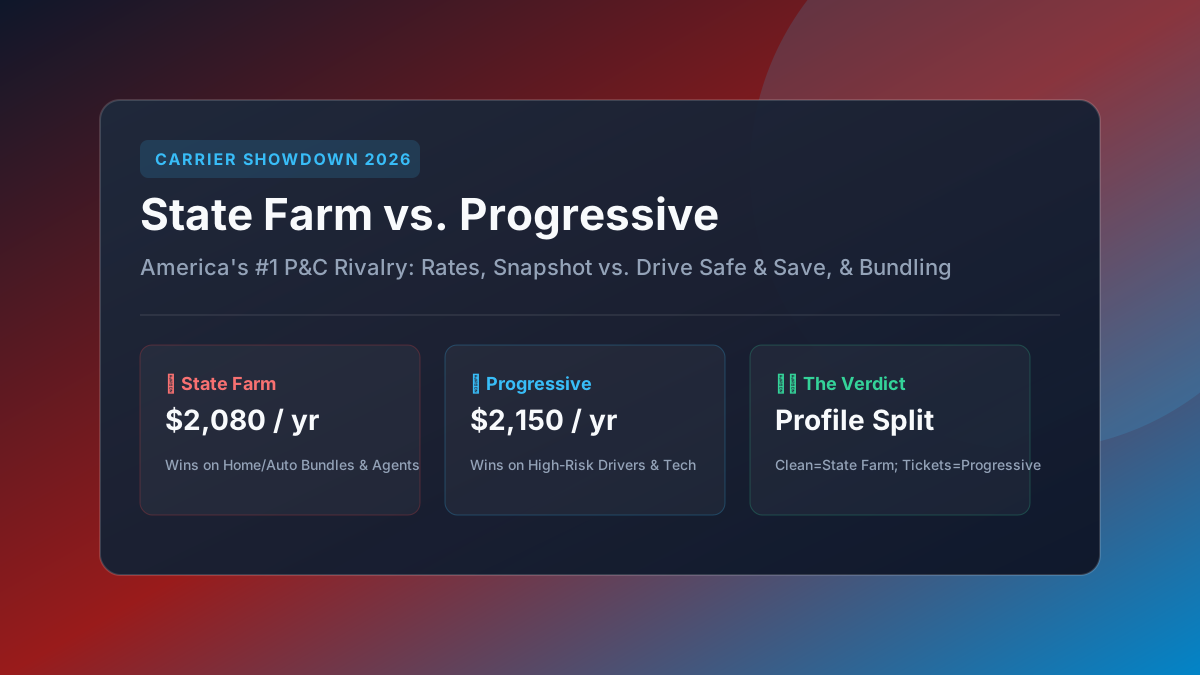
Executive Summary: 2026 Actuarial Findings
- Overall Pricing: State Farm is generally cheaper for clean drivers, families, and home-auto bundles; Progressive wins for drivers with tickets or accidents.
- Telematics Comparison: State Farm Drive Safe & Save guarantees zero rate increases; Progressive Snapshot can raise rates by up to 18% for aggressive drivers.
- Customer Service: State Farm features 19,000+ local captive agents; Progressive excels in digital direct self-service and independent brokers.
- Homeowners Underwriting: State Farm underwrites directly via State Farm Fire & Casualty; Progressive relies primarily on subsidiary ASI and partner networks.
Table of Contents
1. The Titans of American Auto Insurance
State Farm and Progressive collectively control over 35% of the total US private passenger auto insurance market. While State Farm has held the #1 market share ranking for over eight decades, Progressive is rapidly closing the gap through digital quoting innovation and aggressive rate filing optimization.
Deciding between these two giants comes down to your personal risk profile, customer service preference, and whether you prefer an in-person local agent or a modern digital app experience.
2. 2026 Head-to-Head Rate Benchmark
To determine who is truly cheaper, we analyzed 2026 rate submissions across 50 state insurance commissioners for multiple driver profiles:
| Driver Profile / Coverage Tier | State Farm Average | Progressive Average | Winner |
|---|---|---|---|
| Clean Driver (Full Coverage Auto) | $2,080 / yr ($173/mo) | $2,150 / yr ($179/mo) | State Farm (Slight Edge) |
| Driver with 1 Speeding Ticket | $2,480 / yr ($206/mo) | $2,360 / yr ($196/mo) | Progressive (Lower Surcharge) |
| Driver with 1 At-Fault Accident | $2,890 / yr ($240/mo) | $2,710 / yr ($225/mo) | Progressive (Forgiving Pricing) |
| Home & Auto Bundle Package | $3,180 / yr total | $3,420 / yr total | State Farm ($240/yr cheaper) |
| Driver with Poor Credit History | $3,420 / yr ($285/mo) | $3,150 / yr ($262/mo) | Progressive |
3. Telematics: Drive Safe & Save vs. Progressive Snapshot
Both carriers offer mobile usage-based insurance, but their terms differ sharply:
• State Farm Drive Safe & Save: Saves drivers up to 30%. Crucially, State Farm guarantees that your premium will never increase based on your telematics driving data. It is a discount-only program.
• Progressive Snapshot: Saves daytime drivers an average of $156 per year, but roughly 18% of enrolled drivers receive rate increases if they drive late at night (midnight to 4 AM) or brake hard repeatedly.
4. Homeowners Insurance & Bundling Power
When it comes to property protection, State Farm maintains a distinct advantage. State Farm underwrites and services its own homeowners, condo, and renters policies directly through State Farm Fire & Casualty Company.
In contrast, while Progressive owns American Strategic Insurance (ASI / Progressive Home), in many coastal and high-risk states it refers homeowners policies out to third-party affiliated carriers through HomeQuote Explorer. State Farm’s unified multi-policy discount typically yields greater total household savings.
5. The Verdict: Which Carrier Should You Choose?
• Choose State Farm if: You have a pristine driving record, want a dedicated local agent in your neighborhood, and plan to bundle home and auto policies.
• Choose Progressive if: You have a recent moving violation or minor accident, prefer completely online policy management, or want to customize limits using the Name Your Price tool.
Compare Verified 2026 Insurance Rates
Benchmark State Farm vs. Progressive against top Property & Casualty insurers in your ZIP code. Free unbiased quotes in under 2 minutes.
Frequently Asked Questions
Is State Farm really cheaper than Progressive?
State Farm is generally cheaper for clean drivers and homeowners who bundle. However, Progressive is almost always cheaper for drivers with a speeding ticket, accident, or poor credit.
Can Progressive Snapshot raise my rate while State Farm won’t?
Yes. State Farm Drive Safe & Save has a zero-surcharge guarantee, whereas Progressive Snapshot can and does raise rates for approximately 18% of participants.
Which company has better customer service?
State Farm consistently scores higher in J.D. Power customer satisfaction studies, primarily because of its dedicated network of 19,000+ local neighborhood agents.
Do both companies offer accident forgiveness?
Yes. State Farm offers free accident forgiveness after 9 continuous years of clean driving. Progressive offers small accident forgiveness automatically and sells a Large Accident Forgiveness rider.
Compare Related P&C Insurance Guides
Trademark & Non-Affiliation Notice: State Farm®, Progressive®, GEICO®, Allstate®, AAA®, Travelers®, Nationwide®, Liberty Mutual®, Farmers®, USAA®, American Family®, Erie Insurance®, Chubb®, and any other third-party insurer trademarks, service marks, logos, or brand names referenced on this website are the sole property of their respective corporate owners. PolicyGuide USA is an independent consumer research and informational publisher. PolicyGuide USA is not an agent, broker, affiliate, subsidiary, or sponsor of, nor is it endorsed by, any insurance carrier mentioned herein. All references to trademarks and brand names are strictly for identification, consumer education, and comparative analysis under the Nominative Fair Use doctrine of the United States Trademark Act (15 U.S.C. § 1125 / Lanham Act).
Not an Underwriting Carrier or Insurance Broker: PolicyGuide USA is strictly an independent educational and financial technology publisher. We do not sell insurance policies, underwrite risk, process claims, issue insurance binders, or act as an insurance brokerage. Any quote submission, policy consultation, or insurance transaction occurs directly between the consumer and licensed third-party insurance providers or underwriters.
Rate Estimates & Actuarial Accuracy: All rate estimates, benchmark premiums, discounts, and tier comparisons presented are illustrative and derived from publicly available rate filings submitted to state Departments of Insurance (DOI), the National Association of Insurance Commissioners (NAIC), and public consumer surveys. Actual policy terms, underwriting criteria, premium pricing, and eligibility are determined solely by the underwriting insurance carrier based on individual applicant risk factors, including driving history, credit-based insurance score, garaging territory, and requested coverage limits.