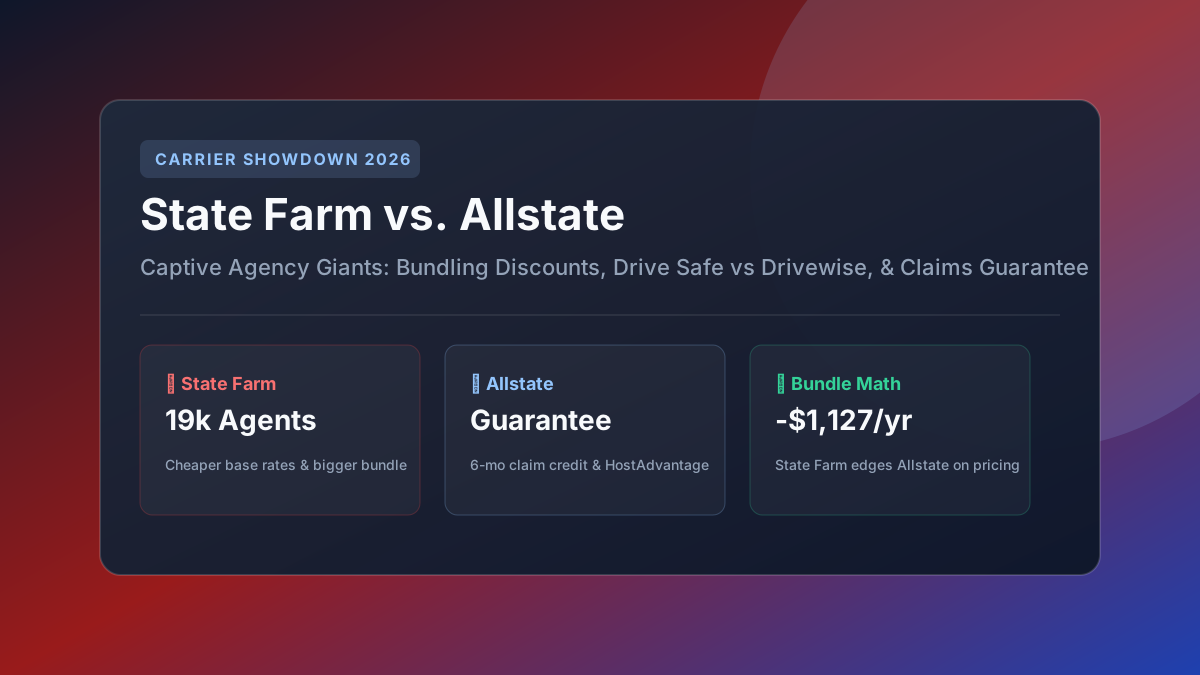
Executive Summary: 2026 Actuarial Findings
- Price Advantage: State Farm is substantially cheaper for full coverage auto ($2,080/yr vs Allstate’s $2,380/yr).
- Claim Guarantees: Allstate provides a Claim Satisfaction Guarantee that refunds up to six months of premiums if unsatisfied with your claim experience.
- Telematics Perks: Allstate Drivewise offers cash back rewards; State Farm Drive Safe & Save offers straight policy discounts with zero surcharge risks.
- Agent Model: Both utilize dedicated captive agents, but State Farm has nearly double the agent footprint (19,000+ vs Allstate’s 10,000+).
Table of Contents
1. The Clash of the Captive Agency Giants
State Farm and Allstate represent the pinnacle of the traditional captive agent insurance model. When you buy a policy from either carrier, you work with a dedicated local agent who knows your community, rather than a nameless call-center algorithm.
However, their pricing, telematics philosophy, and claim guarantees differ noticeably.
2. 2026 Rate Benchmarks: State Farm vs. Allstate
In state rate filings across all 50 states, State Farm almost uniformly beats Allstate on baseline auto and home pricing:
| Coverage Tier | State Farm Average | Allstate Average | Price Advantage |
|---|---|---|---|
| State Minimum Auto Liability | $740 / yr ($62/mo) | $880 / yr ($73/mo) | State Farm ($140/yr cheaper) |
| Full Coverage Auto (100/300/100) | $2,080 / yr ($173/mo) | $2,380 / yr ($198/mo) | State Farm ($300/yr cheaper) |
| Homeowners Insurance ($350k Rebuild) | $1,750 / yr ($146/mo) | $1,980 / yr ($165/mo) | State Farm ($230/yr cheaper) |
| Home + Auto Multi-Policy Bundle | $3,180 / yr total | $3,620 / yr total | State Farm ($440/yr cheaper) |
| Driver with 1 Speeding Ticket | $2,480 / yr ($206/mo) | $2,820 / yr ($235/mo) | State Farm ($340/yr cheaper) |
3. Telematics: Allstate Drivewise vs. State Farm Drive Safe & Save
• State Farm Drive Safe & Save: Provides up to 30% discount. It guarantees your rates will never increase due to tracked driving behavior.
• Allstate Drivewise: Offers an innovative cash-back rewards model. Safe drivers earn cash back deposited directly into their bank accounts every 6 months, plus policy renewal discounts up to 40% in select states.
4. Allstate’s Secret Weapon: Claim Satisfaction Guarantee
Where Allstate justifies its premium price is through its Claim Satisfaction Guarantee. If you are dissatisfied with how Allstate resolves your auto claim for any reason, Allstate will credit your premium for up to six months—no questions asked.
Allstate also offers popular Safe Driving Bonus checks, mailing policyholders a cash refund check for every 6 months completed without an accident.
5. The Final Verdict
• Winner for Price & Value: State Farm. If budget and multi-policy bundling are your primary priorities, State Farm offers comparable coverage at noticeably lower annual costs.
• Winner for Cash Rewards & Guarantees: Allstate. If you want cash refunds for safe driving and the security of a claim satisfaction guarantee, Allstate’s premium features excel.
Compare Verified 2026 Insurance Rates
Benchmark State Farm vs. Allstate against top Property & Casualty insurers in your ZIP code. Free unbiased quotes in under 2 minutes.
Frequently Asked Questions
Why is Allstate more expensive than State Farm?
Allstate includes richer policy features like Safe Driving Bonus checks, Claim Satisfaction Guarantees, and higher operating expenses that contribute to slightly higher baseline premiums.
Does State Farm or Allstate have more agents?
State Farm has approximately 19,000 captive agents across the US, compared to Allstate’s roughly 10,000 local agent locations.
How does Allstate’s Claim Satisfaction Guarantee work?
If you are unhappy with the handling of your auto claim, you write a letter to Allstate within 180 days, and they will credit up to 6 months of your auto premium.
Which company is better for bundling home and auto?
State Farm is generally better for bundling because both policies are underwritten in-house and provide higher combined multi-line discounts.
Compare Related P&C Insurance Guides
Trademark & Non-Affiliation Notice: State Farm®, Progressive®, GEICO®, Allstate®, AAA®, Travelers®, Nationwide®, Liberty Mutual®, Farmers®, USAA®, American Family®, Erie Insurance®, Chubb®, and any other third-party insurer trademarks, service marks, logos, or brand names referenced on this website are the sole property of their respective corporate owners. PolicyGuide USA is an independent consumer research and informational publisher. PolicyGuide USA is not an agent, broker, affiliate, subsidiary, or sponsor of, nor is it endorsed by, any insurance carrier mentioned herein. All references to trademarks and brand names are strictly for identification, consumer education, and comparative analysis under the Nominative Fair Use doctrine of the United States Trademark Act (15 U.S.C. § 1125 / Lanham Act).
Not an Underwriting Carrier or Insurance Broker: PolicyGuide USA is strictly an independent educational and financial technology publisher. We do not sell insurance policies, underwrite risk, process claims, issue insurance binders, or act as an insurance brokerage. Any quote submission, policy consultation, or insurance transaction occurs directly between the consumer and licensed third-party insurance providers or underwriters.
Rate Estimates & Actuarial Accuracy: All rate estimates, benchmark premiums, discounts, and tier comparisons presented are illustrative and derived from publicly available rate filings submitted to state Departments of Insurance (DOI), the National Association of Insurance Commissioners (NAIC), and public consumer surveys. Actual policy terms, underwriting criteria, premium pricing, and eligibility are determined solely by the underwriting insurance carrier based on individual applicant risk factors, including driving history, credit-based insurance score, garaging territory, and requested coverage limits.