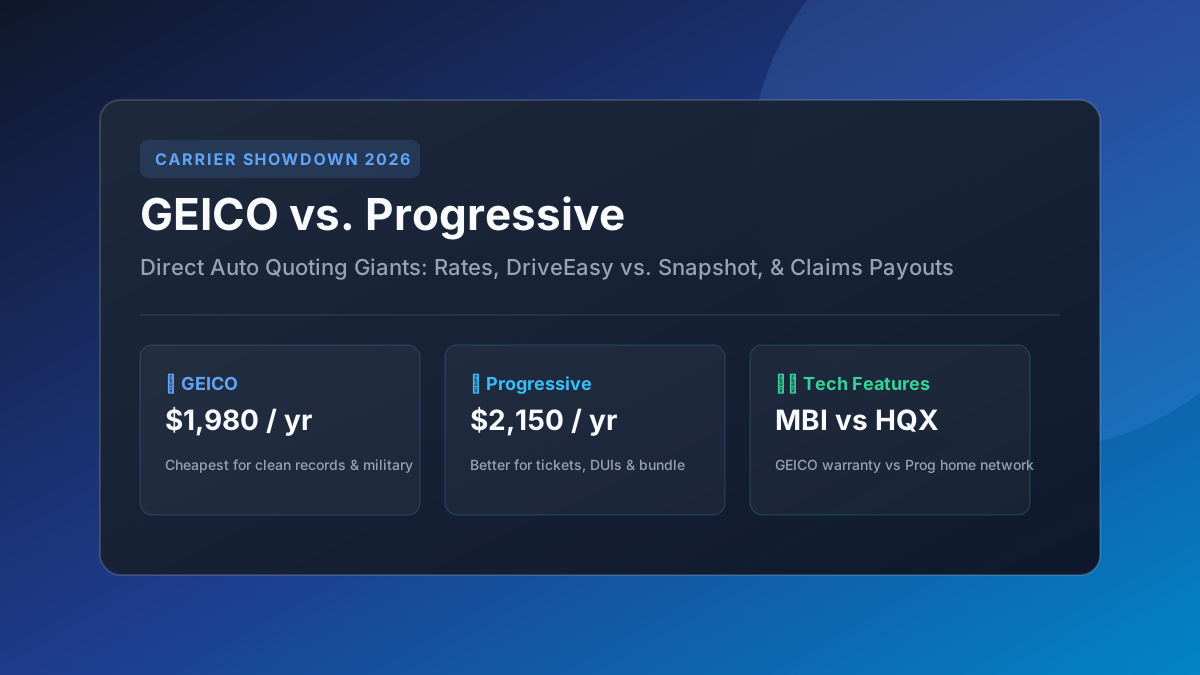
Executive Summary: 2026 Actuarial Findings
- Direct Price Leaders: GEICO generally wins on baseline auto rates for clean drivers and government employees; Progressive wins for non-standard risks.
- Mobile Tech Dominance: Both have top-rated mobile apps (4.8+ stars) with instant ID cards and digital claims tracking.
- Telematics Clash: GEICO DriveEasy vs Progressive Snapshot—both can increase rates for poor driving habits in most states.
- Homeowners Reality: Neither company writes primary homeowners insurance directly at scale; both broker out property coverage through third-party partners.
Table of Contents
1. The Battle of the Direct Insurance Pioneers
GEICO and Progressive built their modern empires by cutting out expensive agent brick-and-mortar commissions and passing savings directly to policyholders via telephone and online quoting.
Today, GEICO (backed by Berkshire Hathaway) and Progressive battle fiercely for the #2 and #3 auto insurance market share spots in America.
2. 2026 Rate Showdown: GEICO vs. Progressive
Our 2026 rate analysis across 50 states reveals a clear dividing line between GEICO and Progressive pricing models:
| Driver Profile | GEICO Average Premium | Progressive Average Premium | Cheapest Option |
|---|---|---|---|
| Clean Driver (Full Coverage Auto) | $1,980 / yr ($165/mo) | $2,150 / yr ($179/mo) | GEICO (Save $170/yr) |
| Minimum Liability Only | $710 / yr ($59/mo) | $790 / yr ($66/mo) | GEICO (Cheaper baseline) |
| Driver with 1 At-Fault Accident | $2,980 / yr ($248/mo) | $2,710 / yr ($225/mo) | Progressive (Save $270/yr) |
| Teen Driver on Parent Policy | $3,490 / yr ($290/mo) | $3,780 / yr ($315/mo) | GEICO |
| Driver with Recent DUI / SR-22 | $3,950 / yr ($329/mo) | $3,250 / yr ($270/mo) | Progressive ($700/yr cheaper) |
3. DriveEasy vs. Snapshot Telematics
Both carriers push telematics heavily to reward safe drivers:
• GEICO DriveEasy: Monitored continuously through the GEICO app. It evaluates braking, acceleration, cornering, and phone interaction. Caution: DriveEasy will increase rates in most states for drivers with low safety scores.
• Progressive Snapshot: Available as a plug-in OBD device or mobile app. Offers an average $156 annual discount, but roughly 18% of participants see a premium surcharge upon completing their tracking period.
4. The Homeowners Bundling Trap
Neither GEICO nor Progressive underwrites the majority of their homeowners policies under their primary corporate balance sheets:
• GEICO acts purely as an agency broker, routing homeowners policies to third-party partners like Travelers, Homesite, Liberty Mutual, or Chubb.
• Progressive underwrites through its subsidiary ASI (Progressive Home) in select markets, but also uses HomeQuote Explorer to broker other carriers.
While you receive a multi-policy discount on your auto policy from both, you may deal with two separate claims adjusters if a storm damages both your house and vehicle.
5. The Verdict: How to Choose
• Go with GEICO if: You have a clean driving record, work for the federal government or military, and prioritize the lowest possible direct auto premium.
• Go with Progressive if: You have tickets or accidents on your record, want the Name Your Price tool, or prefer independent agent support.
Compare Verified 2026 Insurance Rates
Benchmark GEICO vs. Progressive against top Property & Casualty insurers in your ZIP code. Free unbiased quotes in under 2 minutes.
Frequently Asked Questions
Is GEICO cheaper than Progressive for car insurance?
Yes, for clean-record drivers and federal employees, GEICO is typically 7% to 10% cheaper than Progressive. However, if you have tickets or prior accidents, Progressive is often significantly cheaper.
Can GEICO DriveEasy raise my rate?
Yes. In most states, GEICO DriveEasy can increase your insurance premium if your tracked driving behavior displays harsh braking, late-night driving, or phone distraction.
Does GEICO write its own homeowners insurance?
No. GEICO Insurance Agency partners with third-party carriers like Travelers and Homesite to provide home insurance, although the multi-policy discount applies to your auto rate.
Who has better mobile app functionality?
Both carriers have award-winning 4.8-star mobile apps offering instant digital ID cards, roadside assistance tracking, and mobile claims filing.
Compare Related P&C Insurance Guides
Trademark & Non-Affiliation Notice: State Farm®, Progressive®, GEICO®, Allstate®, AAA®, Travelers®, Nationwide®, Liberty Mutual®, Farmers®, USAA®, American Family®, Erie Insurance®, Chubb®, and any other third-party insurer trademarks, service marks, logos, or brand names referenced on this website are the sole property of their respective corporate owners. PolicyGuide USA is an independent consumer research and informational publisher. PolicyGuide USA is not an agent, broker, affiliate, subsidiary, or sponsor of, nor is it endorsed by, any insurance carrier mentioned herein. All references to trademarks and brand names are strictly for identification, consumer education, and comparative analysis under the Nominative Fair Use doctrine of the United States Trademark Act (15 U.S.C. § 1125 / Lanham Act).
Not an Underwriting Carrier or Insurance Broker: PolicyGuide USA is strictly an independent educational and financial technology publisher. We do not sell insurance policies, underwrite risk, process claims, issue insurance binders, or act as an insurance brokerage. Any quote submission, policy consultation, or insurance transaction occurs directly between the consumer and licensed third-party insurance providers or underwriters.
Rate Estimates & Actuarial Accuracy: All rate estimates, benchmark premiums, discounts, and tier comparisons presented are illustrative and derived from publicly available rate filings submitted to state Departments of Insurance (DOI), the National Association of Insurance Commissioners (NAIC), and public consumer surveys. Actual policy terms, underwriting criteria, premium pricing, and eligibility are determined solely by the underwriting insurance carrier based on individual applicant risk factors, including driving history, credit-based insurance score, garaging territory, and requested coverage limits.